Showing posts with label Poland. Show all posts
Wednesday, March 12, 2014
My Book Review of "Bieganski: The Brute Polack Stereotype, Its Role in Polish-Jewish Relations and American Popular Culture"
From Naivety to a Better Understanding of Polish-Jewish Relations and Stereotypes
I just finished reading Bieganski: The Brute Polack Stereotype, Its Role in Polish- Jewish Relations and American Popular Culture by Dr. Danusha Goska. The heart-wrenching, complex realities and stories captured my mind and heart. Goska’s brave and honest writing pulled me in. The information revealed and the topics discussed about Poles and Jews are what most people, in polite conversation, do not want to talk about or bring up. “Don’t go there. It is too touchy.” Goska bravely goes there and brings to the forefront a history of the Polish people and Polish Jews that needs to be openly discussed and understood. Stereotypes have defined these cultures in a negative light for far too long. It is time to understand and look at our assumptions and biases. I give Goska a standing ovation for collecting all this harrowing, at times horrific, yet important, information for her book. Goska’s agenda is not to side with Poles or Jews. Her agenda is to uncover, reveal and discuss an elephant in the room: the misrepresentation and stereotyping of Poles in contemporary culture by some people and organizations. She has introduced me to a whole wide world. Goska writes:
“Stereotyping occurs when insupportable conclusions are drawn from demonstrable facts. These conclusions come from a limited perspective. To the Polish peasant who saw Jews only as tavern keepers or estate managers who lured Poles into excessive drink and then pressured ruined, drunken peasants to pay very high tavern tabs, or pressured desperate serfs to work to fill grain quotas, the Jew is a greedy drug pushing slave driver, no more, no less. To the Jew whose most memorable encounter with a Polish peasant was the Pole who drank to excess and toiled like a mule in the fields, the Pole is a bestial drunk. The Pole did not factor into his assessment the tender Jewish parent, or the intimidated Jew pressured by the Polish magnate to wring the peasants for all they were worth. The Jews did not see the exuberance, generosity and creativity that the peasant displayed with his peers.”
With all stereotyping we choose to see only one side of a story. The simplification of Jewish or Polish culture perpetuates misunderstandings, bigotry and hatred. When you bring into the mix horrific world events like the rise of the Nazis, the Holocaust and the power play Poland experienced at the hands of Russia and the Soviet Union, the stereotypes are compounded by the awfulness and the ugliness of these times and events.
I had not heard of this book and I didn’t really think about Polish and/or Jewish stereotypes much before the spring of 2011. This all changed when I went on a quest to Poland to meet my relatives and to study art history and ethnography through a summer school program at Jagiellonian University in Krakow. I met Dr. Goska on this trip and that is how I learned about Bieganski.
A couple months before I embarked on my trip, I attended a Georgian singing workshop, in a New England town near where I live. I spoke with a man about my plans to travel. When I said I was going to spend a little over a month in Poland, a look of astonishment appeared on his face, followed by a question. “Why would you want to go to Poland?” he scoffed. I was taken aback by the suspicious energy that was driving this inquiry. An awkward pause in our conversation followed. He then said, “The people of Poland are anti-semitic. My nephew was there this past year and he was horrified by what he saw and what he experienced. Poles hate Jews.” His demeanor and blanket definition of a whole race of people alarmed me. Aside from the “dumb-Polack” jokes I heard growing up, this was the first serious run in I’ve had with the stereotyping of Polish people. This “Bieganski” moment shook me awake. Interactions like this one, documented and undocumented, is why Bieganski is such an important book. Bieganski has been an instrumental book in helping me to understand Polish / Jewish relations.
Goska unveils how Poles are stereotyped in popular media by writing extensively of the portrayal of Poles in American cinema and in the press. She devotes early chapters in Bieganski to these fascinating topics. You have to read these chapters to believe it!
Chapter 6: The Peasant and Middleman Minority Theory was particularly eye-opening to read. I found this chapter helpful for understanding the core issues explaining the rise of Polish / Jewish stereotypes. Jews were the middleman minority in Poland for hundreds of years.
“Middleman minority populations are concentrated in urban, skilled and mercantile professions. Their Socioeconomic status falls between elites and peasants. To some extent, they operate under their own code, and are not limited by the surrounding culture’s taboos that impede business progress for those rooted in their communities (Bonacich 584). Middleman minorities have at least a ritual tie to another territory, and if only in a mythic sense, experience themselves as ‘sojourners.’ The sojourner mindset encourages the choice for easily liquidated professions and the amassing of capital, while at the same time it erects barriers to the forming of bonds with members of what Bonacich calls the ‘host’ society. Bonds are formed with other members of the middleman group, even those geographically distant (585-86; 593).”
Chapter 6 provides a theory and one possible explanation of why relationships between Poles and Jews have not always been smooth, easy or easily understood.
Poles and Poland, as well as the Jews, were victims of the Nazis. Chapter 7 in Bieganski, The Necessity of Bieganski: A Shamed and Horrified World Seeks a Scapegoat, begins to explain the question that I have in all of this. Why are Poles sometimes blamed by Jews and others for the Holocaust? Why are Poles sometimes blamed for allowing the Holocaust to happen? It was Nazi Germany who brought all of this about. Nazi Germany caused the suffering and deaths of millions of Jews AND Polish people and others. The problem is as Goska writes here:
“If one does not single out Poles, whom can one blame? The answer is too terrifying to attract an audience. Given the worlds response to the Holocaust, and to events since, like the auto-genocide in Cambodia, Wladyslaw Bartoszewski wrote:
‘Humanity has failed and continues to fail ... the only people who did not fail and who completely confirmed their humanity were those who responded to this test by making the ultimate choice and who died helping their neighbors. No one living can say that of himself. No on living can - whether for political or polemical reasons - demand it of others.’ ”
I’ve read comments about Bieganski, in book reviews and on the Bieganski blog, where others sometimes want to label Goska as an anti-semite and/or anti-Polish. Both criticisms are flawed and narrow. Bieganski is such an important book because Dr. Goska brings to light stories of Jews and Poles that help air out the the stink that builds up and perpetuates stereotypes. It is time to move beyond the past, towards a more understanding, kind-hearted, compassionate view of the Polish-Jewish history. As long as there is an US and a THEM, there will be stereotypes. Our human selves are flawed yet the religions which represent the Jews and the Poles, Judaism and Christianity, teach kindness, compassion and understanding. Unfortunately, until we can rise higher than our human hurts and gain a level of compassion and forgiveness, there will be negative stereotypes.
Goska writes:
“It is time for people of good will to stop scapegoating, to stop insisting that one ethnic group is uniquely prone to stereotypical thinking. It is time for people of good will to join together to a way to address all stereotypical thinking, including that engaged in by stereotyped people themselves.”
One of the many things I take away from this necessary book is to tread lightly and question assumptions: personal assumptions and assumptions made by others including the media, academia, and world and religious leaders. Bieganski deserves to be widely read and discussed , especially by Polish-Americans, Poles and Jews. It deserves to be included in academic courses about Jewish and Polish relations. The Bieganski issue is not black and white. Goska does a fair and thorough job revealing the shades of gray found in the stories she shares and tells. Goska does not paint the picture that all Poles are good and all Jews are bad, nor vice versa. Instead she walks a fine line in her writing revealing the hurtful stories, both true and untrue, that are perpetuated about these two intertwined cultures and ethnicities.
____________________________________________
Check out Danusha Goska's Bieganski The Blog for more thought provoking reading and links in relationship to Bieganski issues in popular culture. She is now in the process of having her book picked up by a Polish publisher, Wysoki Zamek publishing. I wish her and her publisher the best in this pursuit. See my Amazon review and comment of vote for it here.
Sunday, February 9, 2014
A Fun Morning! Valentine Paper Cut Workshop @ Knack
Last Saturday I had a wonderful morning at Knack teaching paper cut techniques to ten lovely women. I had a full house show up for the workshop and we all gathered around the table and got to work. I talked a bit about Wycinanki, Polish paper cuts. I especially focused on the Kurpie style Polish paper cut which uses a single fold, symmetrical design technique. Some students used the templates I brought to class for their design and other students created their own unique designs. Every paper cut made in this workshop was created by using recycled / up-cycled materials that Knack has gathered or that have been donated to the store. All the women seemed inspired by the class and especially by the design examples I shared from books I bought while studying in Poland and Hungary. A couple Polish/American students came to the class because they wanted to learn a little about their creative, Polish heritage. It feels good to pass on the beauty and heritage of traditions I've found particularly rich and inspiring. I plan to be back to Knack sometime this spring to teach another paper cut class. This time we will create floral paper cut designs. Stay posted for the date which I will announce here and on Facebook once I book the day and time. Thank you to Macey and Amber at Knack for having me teach this class and for taking these pictures which capture the feel of a fun, creative morning at your store.
Sunday, January 5, 2014
Snow Days
I have been enjoying looking at art work online that captures the beauty of winter and this snowy season. A friend recently posted art work done in the early 1900's by Wladyslaw Jarocki on facebook and I found his work beautiful. I love the contrast of the whites, greys, browns and blues of the landscape with the brightly colored scarves and embroidery accents on the traditional clothing of his Polish highlander subjects. I want to give away my black, nylon covered jacket for sheepskin, fleece lined, embroidered coats, woolen stockings, leather boots, long heavy skirts and colorful scarves and dress like these beautiful highland women.
![]() |
| Władysław Jarocki, Żółta chustka oil, canvas |
![]() |
| Wladyslaw Jarocki, "Winter Sun", oil on canvas, 69.5 x 99 cm, private collection |
![]() |
| Wladyslaw Jarocki, "Hunter in Winter", 1915, oil on plywood, 98 x 67 cm, private collection |
And finally since this is the first post of the New Year I think gratitude is the word for 2014. I started a gratitude jar and before going to sleep I will write down on a piece of paper a moment of beauty from the day for which I am grateful. On New Year's Eve this upcoming year I will read about all the positive things that filled up 2014. Among other things, I am grateful for the love of my family and friends, the return of snow, celebrating Christmas again with my mom and dad who came up to visit on New Year's Day bearing beautifully wrapped gifts, birds chirping and singing outside on a walk and nearby my bird feeders and the kisses of my 18 month old, cutie-pie of a boy, Kazmir.
| gifts on New Year's Day with snow just beginning to fall outside |
![]() |
| garden in snow |
![]() |
| My house in the snow |
Thursday, October 31, 2013
Danse Macabre
...and the veil between the worlds is thin.
Happy Halloween.
I'm thinking about my ancestors as All Souls Day approaches. My relatives will be lighting candles by their grave sites in Poland and Hungary tomorrow.
I couldn't help but listen to this song tonight, remembering when it captured my imagination so many years ago as a little girl. And it still captures my imagination! I love this piece by Camille Saint-Saens. Enjoy!
Thursday, September 12, 2013
Another week around the homestead: mental meanderings and links to interesting articles and tasty recipes.
Another week has gone by...
And it is time to post on my blog.
I am posting on a weekly basis these days and have no plans to break from this habit (even if I'm not sure what to write about). This is one of those weeks, I'm not sure what to write about.
Yet, there is always "something" to write about. This week has been about traveling in busy circles, one thing to another and then back to that first thing and on to the third. So please indulge me. I do not have a unified theme to this post. Following will be some thoughts, recipes, stories of work around the homestead, and some inspiring and interesting articles I read.
The approach of fall always seems to up the anti in New England. One becomes soberly aware that winter is approaching and it's time to prepare. Time to get the wood in and stacked, time to harvest and preserve from the garden, time to prepare for opportunities like craft fairs and art sales that happen in the fall around the holidays, time to go back to school and get back to normal work, child care routines.
The icing on the cake was a yucky cold that Kaz and I came down with, made all the worse with the high, hot temperatures we've experienced the last couple of days. Can I just say... blah, blah, blah?
Before we came down with the cold, Grandma and Grandpa came to visit us from PA for a couple days last week. We went out to lunch in Northampton and as you can see, Kaz was really excited about sharing the quesedilla we ordered.
Anyway...
Last weekend we put the finishing touches on a wood shed we built out back in which to stack our wood. There will be no more loose metal roofing blowing about in windy winter storms, yay! The next day Josh decided to slaughter 4 of our old hens who are no longer laying as many eggs. A friend came over to help. I took care of the baby. Really, I was not in the mood to take part in the killing of our hens. I was game to cook them though.
So I made a delicious chicken stock by cooking the bird for 14 hours in a huge stock pot with our home grown potatoes, carrots, garlic, dill and parsley. That night we had a chicken noodle soup for dinner to help us get over our colds. Quart after quart of golden stock made the way to the freezer to be used this fall and winter. Then, tonight I made a homemade chicken pot pie. Oh my, it was good! I've never done this before. It took some work but it was worth it! Here's the Chicken Pot Pie recipe that I roughly followed (substituting fresh vegis and herbs from the garden) with a homemade pie crust recipe. If you find yourself with some chicken meat after making stock all day I highly recommend using the meat this way. Homemade chicken pot pie is the perfect thing for a cool fall/winter evening. Well, yes, it IS still summer and really it IS pretty warm and humid but I had to make use of the food left over from stock making.
I've been rotating back and forth between new paper cut deigns and some embroidery projects this week. I have three new holiday tree of life designs cut and ready to be glued on some paper. I hope to have these images uploaded to the computer in two weeks so I can design the cards and get them off to the printer for my first official holiday sale of the season on October 26th. I am loving doing the paper cuts and embroidery. Both are really relaxing and put me in a quiet, zen like head space. I'll share some of the new images with you soon.
I day dream about traveling and plan trips in my head. Of course, I'd like to go back to Poland and Hungary. It is never to early to start preparing. Even if it takes me a year or two or three to get back to these countries. I've been studying the Polish language through Pimsleurs Polish language recordings. I am making head way! I've finished with the recordings that I have and need to look into finding the next round. I'll see if the library system can come up with something like they did for this first round of recordings. I have a feeling I may need to invest some money into taking my studies up a notch.
On that note, I just read a really inspiring article called , "Why Speak Polish?" by Isabelle Sokolnicka. She writes....
"All jokes aside: Parents, send your kids to Polish school. Don’t let them watch cartoons or sleep in on Saturday mornings. Seriously. Or find some other effective way to teach them your language. Be creative, be tough, but don’t let them forge their identity without discovering this important part of being Polish.
You’re still unconvinced? What about…:
The fact that there is something strangely beautiful in the unpronouncability of Polish names or the interminable chains of consonants; something unique about a Slavic tongue born in the heart of Europe, and influenced by languages as different as French, Hungarian, German, Italian or Turkish.
And that there is something indescribable and unqualifiable about the subtlety of Polish poetry. The delicacy and depth of the vocabulary, its capacity to represent movement and perspective like no other language, and the very wide range of prefixes and suffixes that can completely alter the meaning of any word are all elements that permit nuanced expressions of specific emotions or particular settings, and on top of that all – with very few words: the perfect ingredients for poetry-making. Read Baczyński, Słowacki, Miłosz and of course Mickiewicz: maybe it’s the authors’ talent but maybe it is also the language that makes it so incredibly natural to step into a true kingdom of literary creativity. Make your kids learn Polish. Make your kids learn Poland. Make them spell solidarność, ojczyzna, or better even – milość. Who knows, this might just be the beginning of a long-lasting love affair with the Polish language… or at least of a friendship with unquestionable benefits."
In the coming years I think I may find myself in Saturday morning Polish school with Kaz. I don't care if I'm the oldest person there!
And now for the icing on the cake... I'll stop my meanderings after this last shout out.
If you are like me and like to lose yourself (or perhaps find yourself) in other countries,
An American Man’s Quest to Become an Old Castilian
is a MUST READ. It's a NY Times article adapted from “The Telling Room: A Tale of Love, Betrayal, Revenge and the World’s Greatest Piece of Cheese,” by Michael Paterniti.
A man finds his "soul place" while on a quest for a particular cheese. Yes, I said cheese! If you are not interest in this piece yet, then I don't know what's wrong with you :-). Something happened to him during his first visit to a small Castilian village. And of course none of it was practical.
"But something happened to me. Even now, I’m not exactly sure what. I have a friend who once told me about the first time he ever took a ferry to an island off the coast of North Carolina, and how he knew, right there on the ferry — with the salt spray and the light off the ocean — that he’d come back to this same spot every year. He’d come to relive that feeling of leaving his old self behind. That annual renewal, the reacquaintance with the person he felt himself to be on that island, was something he wanted to organize his life around. Similarly, Guzmán instantly and improbably became my place. It made no sense, practically speaking."
I can really relate. A simple idea or lead can push you through a rabbit hole towards a soul shaking, life altering, new reality. Connections happen and projects emerge and are created all for the love of a place.
And it is time to post on my blog.
I am posting on a weekly basis these days and have no plans to break from this habit (even if I'm not sure what to write about). This is one of those weeks, I'm not sure what to write about.
Yet, there is always "something" to write about. This week has been about traveling in busy circles, one thing to another and then back to that first thing and on to the third. So please indulge me. I do not have a unified theme to this post. Following will be some thoughts, recipes, stories of work around the homestead, and some inspiring and interesting articles I read.
The approach of fall always seems to up the anti in New England. One becomes soberly aware that winter is approaching and it's time to prepare. Time to get the wood in and stacked, time to harvest and preserve from the garden, time to prepare for opportunities like craft fairs and art sales that happen in the fall around the holidays, time to go back to school and get back to normal work, child care routines.
The icing on the cake was a yucky cold that Kaz and I came down with, made all the worse with the high, hot temperatures we've experienced the last couple of days. Can I just say... blah, blah, blah?
Before we came down with the cold, Grandma and Grandpa came to visit us from PA for a couple days last week. We went out to lunch in Northampton and as you can see, Kaz was really excited about sharing the quesedilla we ordered.
Anyway...
Last weekend we put the finishing touches on a wood shed we built out back in which to stack our wood. There will be no more loose metal roofing blowing about in windy winter storms, yay! The next day Josh decided to slaughter 4 of our old hens who are no longer laying as many eggs. A friend came over to help. I took care of the baby. Really, I was not in the mood to take part in the killing of our hens. I was game to cook them though.
So I made a delicious chicken stock by cooking the bird for 14 hours in a huge stock pot with our home grown potatoes, carrots, garlic, dill and parsley. That night we had a chicken noodle soup for dinner to help us get over our colds. Quart after quart of golden stock made the way to the freezer to be used this fall and winter. Then, tonight I made a homemade chicken pot pie. Oh my, it was good! I've never done this before. It took some work but it was worth it! Here's the Chicken Pot Pie recipe that I roughly followed (substituting fresh vegis and herbs from the garden) with a homemade pie crust recipe. If you find yourself with some chicken meat after making stock all day I highly recommend using the meat this way. Homemade chicken pot pie is the perfect thing for a cool fall/winter evening. Well, yes, it IS still summer and really it IS pretty warm and humid but I had to make use of the food left over from stock making.
I've been rotating back and forth between new paper cut deigns and some embroidery projects this week. I have three new holiday tree of life designs cut and ready to be glued on some paper. I hope to have these images uploaded to the computer in two weeks so I can design the cards and get them off to the printer for my first official holiday sale of the season on October 26th. I am loving doing the paper cuts and embroidery. Both are really relaxing and put me in a quiet, zen like head space. I'll share some of the new images with you soon.
I day dream about traveling and plan trips in my head. Of course, I'd like to go back to Poland and Hungary. It is never to early to start preparing. Even if it takes me a year or two or three to get back to these countries. I've been studying the Polish language through Pimsleurs Polish language recordings. I am making head way! I've finished with the recordings that I have and need to look into finding the next round. I'll see if the library system can come up with something like they did for this first round of recordings. I have a feeling I may need to invest some money into taking my studies up a notch.
On that note, I just read a really inspiring article called , "Why Speak Polish?" by Isabelle Sokolnicka. She writes....
"All jokes aside: Parents, send your kids to Polish school. Don’t let them watch cartoons or sleep in on Saturday mornings. Seriously. Or find some other effective way to teach them your language. Be creative, be tough, but don’t let them forge their identity without discovering this important part of being Polish.
You’re still unconvinced? What about…:
The fact that there is something strangely beautiful in the unpronouncability of Polish names or the interminable chains of consonants; something unique about a Slavic tongue born in the heart of Europe, and influenced by languages as different as French, Hungarian, German, Italian or Turkish.
And that there is something indescribable and unqualifiable about the subtlety of Polish poetry. The delicacy and depth of the vocabulary, its capacity to represent movement and perspective like no other language, and the very wide range of prefixes and suffixes that can completely alter the meaning of any word are all elements that permit nuanced expressions of specific emotions or particular settings, and on top of that all – with very few words: the perfect ingredients for poetry-making. Read Baczyński, Słowacki, Miłosz and of course Mickiewicz: maybe it’s the authors’ talent but maybe it is also the language that makes it so incredibly natural to step into a true kingdom of literary creativity. Make your kids learn Polish. Make your kids learn Poland. Make them spell solidarność, ojczyzna, or better even – milość. Who knows, this might just be the beginning of a long-lasting love affair with the Polish language… or at least of a friendship with unquestionable benefits."
In the coming years I think I may find myself in Saturday morning Polish school with Kaz. I don't care if I'm the oldest person there!
And now for the icing on the cake... I'll stop my meanderings after this last shout out.
If you are like me and like to lose yourself (or perhaps find yourself) in other countries,
An American Man’s Quest to Become an Old Castilian
is a MUST READ. It's a NY Times article adapted from “The Telling Room: A Tale of Love, Betrayal, Revenge and the World’s Greatest Piece of Cheese,” by Michael Paterniti.
A man finds his "soul place" while on a quest for a particular cheese. Yes, I said cheese! If you are not interest in this piece yet, then I don't know what's wrong with you :-). Something happened to him during his first visit to a small Castilian village. And of course none of it was practical.
"But something happened to me. Even now, I’m not exactly sure what. I have a friend who once told me about the first time he ever took a ferry to an island off the coast of North Carolina, and how he knew, right there on the ferry — with the salt spray and the light off the ocean — that he’d come back to this same spot every year. He’d come to relive that feeling of leaving his old self behind. That annual renewal, the reacquaintance with the person he felt himself to be on that island, was something he wanted to organize his life around. Similarly, Guzmán instantly and improbably became my place. It made no sense, practically speaking."
I can really relate. A simple idea or lead can push you through a rabbit hole towards a soul shaking, life altering, new reality. Connections happen and projects emerge and are created all for the love of a place.
Thursday, September 5, 2013
My new love... Embroidery!
I discovered something new about myself this week. I love to do embroidery. I had a hunch that I would really like to do this and I was right. I've enjoyed admiring and looking closely at embroidery for a long time. Now it feels so good to be doing it!
Last Saturday I took a two hour workshop on embroidery at a new, truly awesome, re-use center/store called KNACK in Easthampton at the Eastworks building. Knack is a DIY palace. The store takes used things, sometimes on the way to being discarded, and brings new life to these things as potential and transformed arts and crafts items. I love the idea behind creating a store like this. Upcycling and reusing materials is a great way to transform items and the workshop space encourages community to learn to do things for themselves. Here is Knack's mission statement...
Knack: The Art of Clever Reuse is a creative reuse center where you can:
- Find all sorts of reusable materials for your creative projects
- Take a workshop or drop in during our open studio time
- Have a party (birthday, craft night, creative gathering, etc.)
- Shop for upcycled gifts/art handmade by local artists
The photo above is of my completed project from the workshop. Bonnie gave us a template to work with and all of the materials to create a sachet. We got to try out 6 different embroidery stitches while creating this pretty, fragrant sachet, stuffed with lavender, camomile and flax seeds.
I find that doing needle work is really very relaxing to me...like weeding a garden or knitting a scarf. Repetitive, task oriented work makes me happy and puts me in a mentally and physically relaxed state. This activity is becoming a nice way to end a busy day full of child care and play, work, household chores, gardening and cooking. Plus I feel like I'm making progress with my creative practice since the sewing links up with the creative work I am now doing. It's a win/win situation!
At home, before taking this workshop, I've been playing around with simple watercolor patterns and incorporating hand stitched elements into them. I've been really attracted to the sun symbol motifs carved into wood of decorative Zakopane architectural elements and furniture in Poland. I'm making little images with gouache, paper, and thread using simple folk art motifs. Here's a work in progress at my work table.
I'll be happily embroidering as well as making new paper cuts and little paintings to prepare for the full season of craft fairs and holiday events in the coming months. I'll post more news on these events in a future blog post.
Monday, August 5, 2013
Summer Harvest Time Begins
It's that special time in late summer when the hard work in the spring begins to really pay off. The counters and the table in my kitchen begin to be cluttered with what was picked from the gardens in the last day or so.
The old claw foot bathtub is now a garden and full of canna lilies, calla lilies, dahlias, geraniums, gladiolas and morning glory.
Today I picked a whooping 13 peaches off the peach tree. My biggest harvest yet!
I created a hay bale, raised bed at the base of the terrace garden hill in which to grow squash. The plants are quite happy as they grow and spill out over the edge of the haybales onto the meadow and hillside. It looks like we'll be eating a lot of spaghetti and butter cup squash.
The sunflower greeting the morning rays is a pretty sight. Under her grows some kale, peppers and a volunteer tomatillo.
The cherry tomatoes are just beginning to ripen.
After looking around my garden at home I headed around the block to my community garden plot at the Raspberry Hill Community Garden. The space is a very special place where the sounds and beauty of the country nourish my soul. The crickets are chirping, the swallows fly and swoop over the garden and big old maple trees line the lane. The land, also known as the Guyette Farm, was gifted to the Franklin Land Trust by Evelyn Guyette. The gardens are situated on a beautiful spot overlooking hills to the west. The sunsets are gorgeous and the cloud watching is excellent. I got a late start with my plot this year. It's my first year working the land here and a lot of sod needed to be lifted in order to create my garden beds. Finally they are all planted and beginning to really thrive. I'm growing carrots, beets, dill, cabbage, potatoes, kale, onion, leeks, green beans, cucumbers and a cherry tomato. I really love being a part of this group of talented and dedicated gardeners and look forward to spending more time here with the land and with others in the years to come.
Let's walk through the gate and take a peak at the gardens.
The blueberries are ripening in the sun and the old barn is in view over the raspberry brambles.
Cloud watching to the west.
My plot is pictured below in the foreground. All the plants are relatively young but they are coming along. I think they'll do really well growing big and strong during the warm month of August into September before the frosts come.
At home again, Kaz came out to the garden with me after his morning nap. He enjoys throwing around the dirt and mulch as I prep a bed to plant more lettuces.
We've been having fun making cordials and fermenting various items from the great outdoors. Last week we spent an hour picking the wild cherries which are abundant this year on Stage Road. The cherries are sitting in various combinations of vodka, gin and sugar to become cordials to be enjoyed this fall and winter. I have a rose cordial in the makes. Once the elderberries are ripe they will be used to make our special immunity boosting cordial. I have a batch of pickles fermenting in a crock. It's my first time trying to make this fresh fermented pickle. I got the recipe out of my new Polish cook book, "From A Polish Country House Kitchen". Josh and a friend made a big batch of dandelion wine which is aging in corked bottles in the closet. I've been wanting a chest freezer for a long, long time and just recently we purchased a used one to put in the garage. It's holding a nice amount of rhubarb, raspberries and blueberries so far. I like to look in it and dream about the good food we'll be eating this winter.
OK, lets leave the kitchen, go outside and take a look in the gardens! Right out the front door is a scramble of marigolds, geraniums, lantana, snapdragons, new guinea impatiens, canna lillies, mint, and salvia in colorful pots on the front porch.
The old claw foot bathtub is now a garden and full of canna lilies, calla lilies, dahlias, geraniums, gladiolas and morning glory.
Today I picked a whooping 13 peaches off the peach tree. My biggest harvest yet!
I created a hay bale, raised bed at the base of the terrace garden hill in which to grow squash. The plants are quite happy as they grow and spill out over the edge of the haybales onto the meadow and hillside. It looks like we'll be eating a lot of spaghetti and butter cup squash.
The sunflower greeting the morning rays is a pretty sight. Under her grows some kale, peppers and a volunteer tomatillo.
The cherry tomatoes are just beginning to ripen.
After looking around my garden at home I headed around the block to my community garden plot at the Raspberry Hill Community Garden. The space is a very special place where the sounds and beauty of the country nourish my soul. The crickets are chirping, the swallows fly and swoop over the garden and big old maple trees line the lane. The land, also known as the Guyette Farm, was gifted to the Franklin Land Trust by Evelyn Guyette. The gardens are situated on a beautiful spot overlooking hills to the west. The sunsets are gorgeous and the cloud watching is excellent. I got a late start with my plot this year. It's my first year working the land here and a lot of sod needed to be lifted in order to create my garden beds. Finally they are all planted and beginning to really thrive. I'm growing carrots, beets, dill, cabbage, potatoes, kale, onion, leeks, green beans, cucumbers and a cherry tomato. I really love being a part of this group of talented and dedicated gardeners and look forward to spending more time here with the land and with others in the years to come.
Let's walk through the gate and take a peak at the gardens.
The blueberries are ripening in the sun and the old barn is in view over the raspberry brambles.
Cloud watching to the west.
My plot is pictured below in the foreground. All the plants are relatively young but they are coming along. I think they'll do really well growing big and strong during the warm month of August into September before the frosts come.
At home again, Kaz came out to the garden with me after his morning nap. He enjoys throwing around the dirt and mulch as I prep a bed to plant more lettuces.
Happy August, early harvest time to you! I hope you are enjoying these golden days.
Labels:
baby,
Beauty,
Cooking,
Flowers,
Food,
friends,
Gardens,
Poland,
Sky,
Soul,
Stage Road,
Summer
Monday, July 29, 2013
Stone Upon Stone
I just finished reading "Stone Upon Stone" by Wieslaw Mysliwski, translated from Polish by Bill Johnston. This book was chosen by the University of Rochester as "the finest example of world literature in translation" for the year of 2012.
I found out about this book a few months ago online by a great resource for those of us interested in Polish culture: The Cosmopolitan Review, "A Transatlantic Review of Things Polish, in English".
"Stone Upon Stone" is a raw, honest and human piece of fiction narrated by the protagonist, Szymek Pietruszka. The memories from his life are sometimes brutal, other times funny, lovingly tender and often painful. His recollections are sometimes poetic and poignant and other times long winded and rambling.
The book is set in communist era Poland in the mid to late 20th century. The story weaves back and forth as Szymek sets forth a stream of consciousness recalling memories from his childhood, young adulthood, time fighting in World War II, and adulthood as he looks back from the perspective of the winter of his life. His memories come to the surface as he prepares to build a tomb in which to be buried. So many rich stories and perspectives roll from page to page. I felt like I was a part of Szymek's mental wanderings and intimately witnessed his 20th century life, lived as a peasant in a small village, where he lived so much and saw so much change.
Szymek is the real deal. He's doesn't lead a pretty life. His stories certainly are not sugar coated. He suffered much and his neighbors suffered along side him. Yet you see a resilience and a strength of character through his humanity and humor. At times I cringed while I read about his behavior and actions as he deals with strong emotions related to love: the love of a woman and the love for his invalid brother. Szymek lets the reader in to witness both his dark side and light side. My heart ripped open as I read his first hand account about fighting in World War II and what kind of atrocities he witnessed during that time. He's a man who grows up with all aspects of raw reality coming to him. It's one event after another: abuse, war, hunger, hard work and hard drinking, love gained and lost. I wonder if his story mirrors the story of Poland? Poland greatly suffered during the time of Symek's life.
What I most enjoyed about "Stone Upon Stone" is how Szymek remembers the traditions of his family and of the rural peasants in the village in which he lives. He is down to earth, often blunt, as he recalls his memories of working the land, and the traditions and rituals around the holidays. Nothing about this story is veiled with nostalgic memories that shine as if looked through rose colored lenses. Szymek tells things as they were. He remembers hard work mowing the field at harvest...
"Plus harvesttime was getting close. And harvesttime was a curse. From dawn till night you worked like and animal. Your head's pounding from the mowing, your eyes are blinded by sweat. Instead of crossing the sky, the sun just keeps moving to a fro across your back, all the time from when it rises in the east till when it sets in the west. It's like its claws were sunk into your skin. Because it's not even the sun, the sun is what shines over the river and the meadow and the reeds, this thing is a huge bright bird that's got it in for you. The moment you feel like straightening up a bit, it jabs you in the back of the head with its beak. Like it was reminding you your life belongs down below, not up above, that your life is this eternal unmown field you keep moving across, swinging your scythe. And you don't even know if you'll ever finish mowing it. You'll only be done when death takes you."
| Field near Korczyna, Poland |
| Farmer's fields near Zakopane, Poland |
Wednesday, July 17, 2013
Art work by Kazimierz Sichulski
![]() |
| Spring, design stained glass triptych In 1909. Pastel, tempera, cardboard. 145 x 231 cm. The National Museum in Warsaw. |
![]() |
| Palm Sunday (triptych) In 1906. Pastel, gouache and tempera on paper glued on cardboard. The National Museum in Krakow. Girls Hutsul (left part of the triptych Palm Sunday). 136 x 71.5 cm |
![]() |
| Hucułka In 1906. Pastel and gouache on paper. 76 x 56 cm. The National Museum in Krakow. |
![]() |
| Bridesmaid (Hucułka) In 1906. Pastel, tempera, gouache and charcoal on paper. 76 x 55 cm. The National Museum in Krakow. |
I came across some postcards in my studio recently that I purchased at the National Museum in Krakow a couple years ago. The postcards include images of some of the artworks shown above. The artist responsible for these works is Kazimierz Sichulski (1879-1942). I particularly like the paintings that were inspired by Hutsul traditional culture found in the south-eastern Carpathian mountain region. This area, for a time, was part of Poland but is now part of the Ukrainc. Sichulski was born and died in the city of Lviv.
I love the above pieces, as much for their traditional subject matter as for the rendering of the subject with rich expression, harmonious use of color and lyrical line. You get a sense of the beautiful ornamentation on the peasant dress. The lines are organic, graphic and bold. The way the cloth folds on the blouses and headscarves gives you the impression of the feel and weight of the cloth used for these traditional garments. The peasant's features are captivating as you see them here, looking, thinking and praying.
The Hutsul people that captivated Sichulski were mountaineers found in the western part of the Ukraine, Eastern Carpathian mountain region. Sichulski was not alone with his fascination as many artists and ethnographers were inspired by Hutsul traditional culture. Sichulski's artistic career was not only focused on traditional culture. He was a master of caricature and also created religious works. I am most attracted to his Hutsul inspired works.
It is not surprising to me that Sichulski studied with Wyspianski, who is an artist I've written about here on my blog . Wyspianski was inspired by traditional peasant culture in Poland as well. These artists were part of a larger movement called the "Young Poland" movement where something called "Chlopomania" occurred. "Chlopomania" is a Polish term used to describe these artist's fascination with traditional culture, folklore and peasant life. Some artists, playwrights, writers, and members of the intelligentsia at the turn of the century (1891-1918) in Poland felt cautious about, and in some instances, disgust for the modernization around them especially in the cities and politics at this time. They desired to look to nature, return to nature and shun aspects of modern city life. The peasants lived close to nature so they and their customs fascinated and inspired artists. Some of the "Young Poland" artists, like Wyspianski, went so far as to marry peasant women. Another important aspect of this movement was the way in which artists looked for and expressed a strong national identity through traditional culture. This was especially important in Poland as the country for so long was partitioned by it's surrounding countries and political systems. Folklore and peasant life became the subject of many artistic creations. Artists involved with the Young Poland movement were working with thoughts and philosophies that were strongly reminiscent of Romanticism. The Romantic movement revolted against industrialization and the scientific rationalization of nature in artist expression. Romanticism looked to the authentic reality of strong emotion and looked back to traditions, ritual, and awe inspiring nature.
Let's fast forward to the 21st century. At this point in time another wave of interest in our connections with nature, with our farming and food, with our production of goods and even in looking at how we spend time in our families and within communities is gaining more interest and attention. Industrial farming, the outsourcing of manufacturing, and our plugged in culture needs to be looked at. Are we growing healthy food and taking care of the land that grows our food for ourselves and children? Are there meaningful jobs where a worker can feel pride in what they make? Are we sharing meals with our family and friends, having conversations, telling stories, marking important passages of time both personally and within our communties, connecting with something greater than ourselves?
Artists like Kazimierz Sichulski with their interest in and depiction of traditional cultures can show us something today. How are we feeling connected to meaning, health, communities and family and how are we feeling disconnected? One of the reasons I enjoy works of art is for their aesthetically pleasing and/or thought provoking effect. There is a reason I am so inspired by traditional cultures. I feel I can learn something from them and have learned something from them that brings me and my family more meaning, more health and more of a connection to something greater. With this, I think the Young Poland artists and I have something in common.
Sources: Wikipedia
images found here: http://www.pinakoteka.zascianek.pl/Sichulski/Index.htm
Tuesday, June 18, 2013
Kupala Night, Midsummer, Solstice
Light lasts far into the evening and deepens the green of the grass and ferns at the wood's edge to a rich emerald. There lies a cool darkness as I look into the dark woods. Trills of birdsong echo off the trees as creatures settle down for the night. Lightning bugs take flight, dancing upwards from the wildflowers: daisy, clover, buttercups. The pinks and purples of geranium, dianthus, columbine, rose, sage and iris bloom electric in the twilight. Deep pinks and emeralds play together as exquisite opposites.
Midsummer night is here. In Slavic countries Kupala night is celebrated.
Here is a photo and a video of what happens in Poznan, Poland on Kupala night. Thousands of lanterns are lit with fire and float away into the twilight sky. Beautiful isn't it?
Kupala is a Slavic holiday celebrated in Poland, Russia, Ukraine and Belarus. Originally it was a pagan fertility rite, celebrated in June on the longest day of the year. Kupala celebrates the summer solstice. Midsummer night is the festivity of unity, the congress of fire and water, Sun and Moon, man and woman, fertility and harvest, and joy and love. This holiday dates back to pre-christian times. As with most holidays, the pagan holiday was absorbed by the church in some Slavic countries and is celebrated as a holy day honoring St. John the Baptist.
Kupala is a Slavic goddess whose name means to bathe. Interestingly the squatting woman found on many Slavic embroideries is the goddess Kupala. She is the goddess of springs and water. Kupala rules herbs. Wildflowers, ferns and birch trees are sacred to her. She brings about joy, health and cleansing. Her fire aspect leads to purification, transformation and protection.
This longest day and shortest night honors two important elements: water and fire, the sacred feminine, spirit of life, creativity and destruction. Bathing in natural waterways like rivers, streams and lakes is a ritual purification. Water also symbolizes fertility. Fires are burned and around them there is much singing and dancing. Young people jump over the fire to show their bravery and faith. A man and woman jump over the fire while holding hands to see if they will forever stay together. If they fail to make the jump while holding hands it foretells a separation.
Young women weave together beautiful wildflower wreaths and float them on the water with candles. The path of the wreaths in the water can foretell about the woman's fate in love. Woven flower wreaths are worn on an unmarried woman's head. In Polish this flower garland is called wianek.
At night the maidens enter the forest, followed by the young men to look for herbs and the mythic fern flower which brings prosperity and luck in life to anyone who finds it.
Information and images from:
Youtube, Pinterest, Wikipedia
(http://en.wikipedia.org/wiki/Kupala_Night) and
http://journeyingtothegoddess.wordpress.com/2012/01/19/goddess-kupala/
Midsummer night is here. In Slavic countries Kupala night is celebrated.
Here is a photo and a video of what happens in Poznan, Poland on Kupala night. Thousands of lanterns are lit with fire and float away into the twilight sky. Beautiful isn't it?
Kupala is a Slavic holiday celebrated in Poland, Russia, Ukraine and Belarus. Originally it was a pagan fertility rite, celebrated in June on the longest day of the year. Kupala celebrates the summer solstice. Midsummer night is the festivity of unity, the congress of fire and water, Sun and Moon, man and woman, fertility and harvest, and joy and love. This holiday dates back to pre-christian times. As with most holidays, the pagan holiday was absorbed by the church in some Slavic countries and is celebrated as a holy day honoring St. John the Baptist.
Kupala is a Slavic goddess whose name means to bathe. Interestingly the squatting woman found on many Slavic embroideries is the goddess Kupala. She is the goddess of springs and water. Kupala rules herbs. Wildflowers, ferns and birch trees are sacred to her. She brings about joy, health and cleansing. Her fire aspect leads to purification, transformation and protection.
This longest day and shortest night honors two important elements: water and fire, the sacred feminine, spirit of life, creativity and destruction. Bathing in natural waterways like rivers, streams and lakes is a ritual purification. Water also symbolizes fertility. Fires are burned and around them there is much singing and dancing. Young people jump over the fire to show their bravery and faith. A man and woman jump over the fire while holding hands to see if they will forever stay together. If they fail to make the jump while holding hands it foretells a separation.
Young women weave together beautiful wildflower wreaths and float them on the water with candles. The path of the wreaths in the water can foretell about the woman's fate in love. Woven flower wreaths are worn on an unmarried woman's head. In Polish this flower garland is called wianek.
At night the maidens enter the forest, followed by the young men to look for herbs and the mythic fern flower which brings prosperity and luck in life to anyone who finds it.
Information and images from:
Youtube, Pinterest, Wikipedia
(http://en.wikipedia.org/wiki/Kupala_Night) and
http://journeyingtothegoddess.wordpress.com/2012/01/19/goddess-kupala/
Monday, June 10, 2013
A Call from the Ancestors: Picking up the threads
| Hungarian Embroidery at Budapest's Folk Art Festival, August 2011 |
I have been following personal threads of identity, authenticity, passion, connection and resonance. Sometimes I happen to find threads to follow. Other times I go searching for a colorful thread. I find it particularly magical when a thread finds me. Another strand is sewn into my story, the work I am doing, the studies that I am pursuing and the life I am creating. This is a very personal journey and at the same time the embroidery involves bigger pieces of history, story and culture. It is the fabric of lives.
I found this quote about threads in a tapestry from a poem which describes my sentiments exactly:
"Every intention, interaction, motivation, every colour, every body,
every action and reaction, every piece of physical reality and the
thoughts that it engendered, every connection made, every nuanced moment
of history and potentiality, every toothache and flagstone, every
emotion and birth and banknote, every possible thing ever is woven into
that limitless, sprawling web.
"It is without beginning or end. It is complex to a degree that humbles the mind. It is a work of such beauty that my soul wept...
"...I have danced with the spider. I have cut a caper with the dancing mad god.”
― China Miéville, Perdido Street Station
There was a time, in 2010 and 2011, when I worked with a mentor, Valerianna, who is an artist and friend at RavenWood Forest Studio of Mythic and Environmental Arts. I was looking to connect on a deeper level with my art practice. I needed perspective, a sounding board, someone I could talk with who understood what I was wrestling with. Questions about authenticity and identity in my art practice loomed large. The desire to create something meaningful and beautiful has been a
driving force in my life. Creativity needs an outlet. A dialogue of
meaning about authenticity, identity and beauty is an important conversation that
happens in my head as I begin new work. I think about these things and feel them out
in order to bring forth something into the physical world.
AUTHENTICITY
PASSION
CONNECTION
RESONANCE
For a while, months and months, things were muddy, murky and not at all clear as I worked with my mentor, sketched and wrote in my journal. I was wondering if I was really making any progress? When will my vision for my arts practice become clearer? Will I ever be more confident in understanding the motivation for my creative work? Out of no where all of that changed.
Bobbie Sumberg's book, "Textiles", full of beautiful, intricate and colorful threaded embroidery was the catalyst pointing me towards the path I am on. It stopped me in my tracks while perusing the shelves at the library in the winter of 2011. The book is full of textiles from all around the world. It contains photographs of some beautiful examples of Hungarian folk embroidery. As I briefly flipped through the photographs the Hungarian designs, colors and patterns struck me to the core. I knew I had to pay attention to this feeling so I took the book home with me.
The next morning I turned on the local college radio station. I began to look more closely at the intricate Hungarian embroidery work in the book. Unbeknownst to me, a polka show was on at that time. This got my attention. In between upbeat polkas, advertisements for local Polish businesses were played. I live in an area, the Pioneer Valley, with a large Polish-American population. After some time listening to the polka show and looking at the book I thought I'd look up Hungarian and Polish arts in western Massachusetts on Google. Low and behold a Polish art class was to begin at the Springfield Museum the next month. I signed up for it.
These seemingly small events lined up at about the same time and got my attention. The messages coming to me were closely related to my heritage: the blood flowing through my veins. The hours spent alone in thought that winter morning, enjoying a book and listening to the radio woke me up. My Hungarian and Polish ancestors seemed to be gently shaking me, waking me up to what is there, what is here and what is in me. I was surrounded by eastern European stimulation that was sure to get my attention. Within 24 hours I awoke to a path. The path appears through a deeper connection with my heritage. The minor threads began an important journey that grow in different directions. I need to look forward, backward and be in the moment.
Lives are weaving together. My life with my ancestors, my living relatives, new friends and mentors. Threads of inspiration, love and longing drive me to read books, ask questions, look at images, learn the Polish language, create new art work, designs, paintings, paper-cuts and keep in touch with my relatives and the friends I met while traveling in Poland and Hungary. Stories and history are there to learn from and help me gain understanding. Places beckon me to return.
Perhaps, I've simply become aware of my place within a complex embroidery that has existed all along. The colorful threads continue to manifest, come together and take shape, weaving something I can recognize and see with some perspective. And yet a lot of work remains to be done. At times this is a wide and deep mystery. I'm left asking why.
I've always been attracted to strong colors and bold, graphic design, especially designs that connect with the natural world. For a while southwest and Mexican arts were a big inspiration to me but something was missing, a very personal connection. I felt like a tourist. I didn't feel complete and my work didn't feel grounded. I needed to connect with something deeper. Who am I? Why am I attracted to certain sounds, colors and patterns so strongly that I truly become awestruck? Why, musically, have I always been inspired by gypsy and eastern European music, violins, accordions, minor keys, edgy harmonies, singing and sounds of longing that pull on your heart strings? After looking deeply at the Hungarian embroidery in the textile book I realized what is going on. Aha!
The garments, like the man's mantle pictured below, wedding dress, bodices, hair pieces and many more items were sewn with such care, such love and such attention to detail. Flowers bloom in vibrant colors, patterns form a kind of rhythm of elements in the dress. The costumes exhibit such pride and joy for one's culture, one's life and one's connection with nature and the traditions of their region. The skill was passed on woman to woman, mother to daughter, grandmother to grand-daughter, generation to generation. These people lived such busy lives growing food and gardens, growing materials for their homespun linen cloth, making and mending clothing, doing household and farm chores, preserving food and the list of the hard work goes on. All this work was done everyday without the modern conveniences we have today. And it was still important to the women to spend time and attention doing intricately sewn handwork to make their lives reflect even more beauty. I so admire the skill and hard work that went into many traditional practices. I like the do-it-yourself resourcefulness that was a necessity in the past. I know I long to connect more to that kind of resourcefulness and I don't think I am alone. I believe my life is infused with more meaning when I can enjoy creating some of the things I use and need. The beautiful Hungarian and Polish embroidery I love to look at, the pieces my ancestors must have made and my drawer filled with doilies that my grandmother and great-grandmother made inspire me and reminds me of this.
My ancestors have been calling out to me. I've been looking for my own personal story, my history and the story of my ancestors. All along I wanted to deeply connect with my ancestor's traditions, lands, sounds, smells, foods, colors, plants, designs relating to the natural world. The Hungarian embroidery work woke me up to this reality. This is my quest. All along I was attracted to certain styles, music and aesthetic in relation to my personal heritage, my Eastern European roots. This led me to realize a vision, an adventure and a shift in my creative work. I decided to take a trip of a lifetime to connect with my family and the land and villages in Poland and Hungary. All this has brought me much curiosity, depth and meaning to my creative practice and work. My experience continues to sustain and feed me. I've created a line of gouache paintings and paper-cut designs which are available as blank greeting cards and archival prints. The graphic, bold designs and bright colors used in my work and inspired by eastern European folk embroidery feel right aesthetically and appeal to me. They are a wink and a nod to the beautiful embroidery designs that I find so lovely. So many more ideas and images swim around my head, waiting for when I have chunks of uninterrupted time in my studio and at my easel to explore, paint and cut paper. This is the rabbit hole I fell down two years ago and now there is no turning back. The journey is deep and vast. The more connections I make the more I want to know. One lifetime doesn't seem long enough to get to the bottom of my desire for understanding.
| Hungarian Embroidery, Budapest's Folk Art Festival, 2011 |
Monday, June 3, 2013
Peasant Homes and Gardens
![]() |
| Peasant Cottage at Skansen Wygielzowie in Poland |
| Zakopane house and garden |
| Skansen window |
| Skansen garden |
This post is a little collection of some inspiring pictures of peasant cottages and their gardens. I can't get over the simple use of color around the the windows and between the logs of the cottage in the first photo. Turquoise and cobalt blue is one of my favorite color combinations.
All but the first photo here were taken by me two summers ago while I was in Poland. There are a number of lovely Skansens (outdoor and living history museums) in Poland that preserve folk, wooden architecture. Some towns are known for their existing homes exhibiting and/or preserving old architectural styles, Zakopane being one of them.
The old peasant homes breathe with life. A thatched roof, dirt floor and wooden walls, all organic and natural materials, allow the home to literally breathe. This makes me think of Hundertwasser and his manifesto where he proclaims that the space we inhabit, the architecture of our dwellings, is like another layer of skin. Our architecture is a layer outside our physical layer of skin surrounding our bodies and the layer of clothes we wear. Soon I will write more about old folk architecture, what I know and learned from my travels and reading.
For now...
There is a lot of work to do at home in my garden this time of year. I'm am feeling particularly busy, grounded and centered around the home with all that needs to get done. I haven't been able to sit at my computer to write much. But, gardening is an excellent activity for gathering one's thoughts! The writing will come.
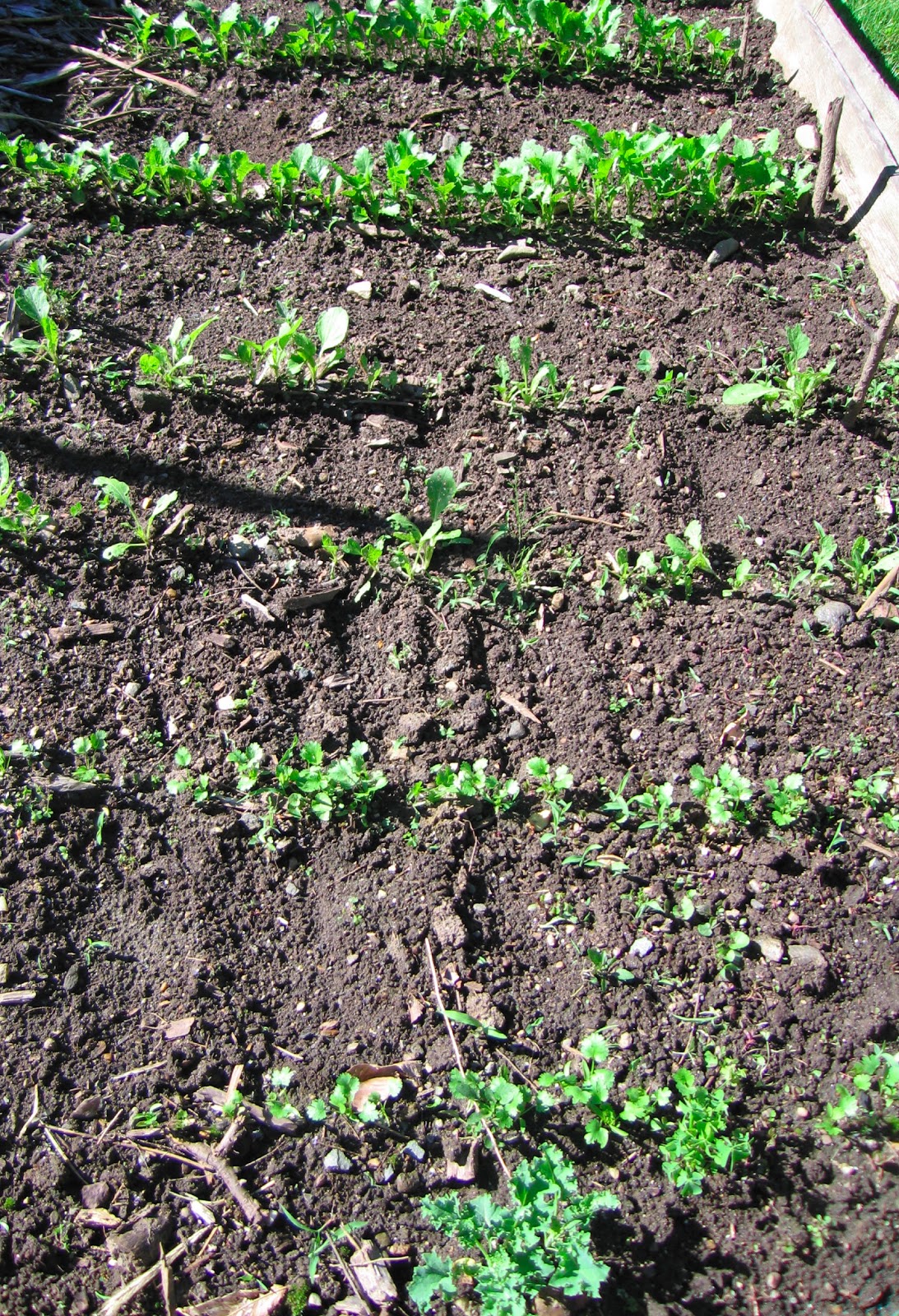
The weeds grow fast next to the seedlings that are just sprouting. Then there is the thinning that needs to get done so that the seedlings coming up do not crowd one another. Some vegetable beds still need to be made and planted with beans, carrots and beets at the community garden plot down the street. At home, I'm going to make a hay bale raised bed in which to plant the delicata and spaghetti squash so they can grow down the hill towards the woods, out of the way of our other garden beds. Radishes, potatoes, garlic, cilantro, arugula, lettuces, horseradish and spinach are up. Some basil and tomatoes are in. Today I'm going to a flower nursery to buy some annuals to put in pots and hanging baskets around the house. Soon I will be caught up, ahead of the weeds and enjoying watching the summer growing of all the plants, flowers and food on the land.
Photos of my garden taken this morning...
Subscribe to:
Posts (Atom)


.jpg)


.jpg)