Showing posts with label Polish Art. Show all posts

Thursday, January 16, 2014

Making Valentine's Cards: Up-cycled, Paper Cut Workshop February 1st


Last month I created the above example and template of a hand made, paper cut, Valentine using paper remnants I found in my scrap paper folder for an upcoming work shop I'm teaching at KNACK: The Art of Clever Re-Use, in Easthampton, MA. The workshop takes place in a couple weeks, on Saturday morning, February 1st, from 10am until 12pm. Spots are still open if you want to join me!

I'm really looking forward to teaching an art class again as it has been a number of years since I've been in a teaching role, encouraging other's creative energy and talents. Yes, in a past life, before I moved to western MA, I was an art teacher to middle school and high school students.

I took two embroidery classes at KNACK this fall and had a ball! It was wonderful to get out of the house on a Saturday morning. I walked into KNACK with the smell of a fresh pot of coffee brewing, greeting my senses and one of the friendly owners there to welcome us. All the workshop attendees soon gathered around the table and got to work with a wonderful and talented teacher. We all learned something new that morning and it was inspiring to be in KNACK's studio space.

I just got confirmation today that the workshop is a GO since I have enough people enrolled in the class to allow it to happen. And there are still some spots available if you want to join us at KNACK's fabulous creative re-use lounge. I included the following information taken from KNACK's website which shares all the info and links you need to find out more info and enroll in the workshop.

Class Description

Valentine’s day is just around the corner!  Make unique cards to give to loved ones (or keep for yourself!). Paper Cutting is an art form that is practiced by different cultures all around the world.

You will learn about the Polish form of paper cutting called “Wycinanki”; the Kurpie style of cutting from Poland is the inspiration for the projects in this workshop. This style cut out is made from one piece of paper that is folded in half, down the middle. You'll create beautiful cards to take home, and  learn the skills to make many more on your own.
Details 
 Saturday, February 1st
10am-12pm
Taught by Kim Wachtel
Cost: $30

Pre-registration required
Class size limited to 10
Sign up

Stop by during regular business hours to register for this class, or you may sign up online.

Register for Workshop!


Our cancellation policy can be found at the bottom of the Workshop listings page.
Questions
 Contact us! We can be reached at 413-529-0126 or info@knack.org.

Thursday, September 5, 2013

My new love... Embroidery!


I discovered something new about myself this week. I love to do embroidery. I had a hunch that I would really like to do this and I was right. I've enjoyed admiring and looking closely at embroidery for a long time. Now it feels so good to be doing it!

Last Saturday I took a two hour workshop on embroidery at a new, truly awesome, re-use center/store called KNACK in Easthampton at the Eastworks building. Knack is a DIY palace. The store takes used things, sometimes on the way to being discarded, and brings new life to these things as potential and transformed arts and crafts items. I love the idea behind creating a store like this. Upcycling and reusing materials is a great way to transform items and the workshop space encourages community to learn to do things for themselves.  Here is Knack's mission statement...

Knack: The Art of Clever Reuse is a creative reuse center where you can:
  • Find all sorts of reusable materials for your creative projects
  • Take a workshop or drop in during our open studio time
  • Have a party (birthday, craft night, creative gathering, etc.)
  • Shop for upcycled gifts/art handmade by local artists
A woman named Bonnie Sennott taught the workshop. I was really impressed with her embroidered art pieces. She creates abstract images with embroidery stitches which I found beautiful and inspiring. She has a blog, Blue Peninsula Knits, which is full of her projects and examples of her many creative talents. She is a talented knitter as well as a knit pattern creator.

The photo above is of my completed project from the workshop. Bonnie gave us a template to work with and all of the materials to create a sachet. We got to try out 6 different embroidery stitches while creating this pretty, fragrant sachet, stuffed with lavender, camomile and flax seeds.

I find that doing needle work is really very relaxing to me...like weeding a garden or knitting a scarf. Repetitive, task oriented work makes me happy and puts me in a mentally and physically relaxed state. This activity is becoming a nice way to end a busy day full of child care and play, work, household chores, gardening and cooking. Plus I feel like I'm making progress with my creative practice since the sewing links up with the creative work I am now doing. It's a win/win situation!

At home, before taking this workshop, I've been playing around with simple watercolor patterns and incorporating hand stitched elements into them. I've been really attracted to the sun symbol motifs carved into wood of decorative Zakopane architectural elements and furniture in Poland. I'm making little images with gouache, paper, and thread using simple folk art motifs. Here's a work in progress at my work table.
I'll be happily embroidering as well as making new paper cuts and little paintings to prepare for the full season of craft fairs and holiday events in the coming months. I'll post more news on these events in a future blog post.

Monday, July 29, 2013

Stone Upon Stone


I just finished reading "Stone Upon Stone" by Wieslaw Mysliwski, translated from Polish by Bill Johnston. This book was chosen by the University of Rochester as "the finest example of world literature in translation" for the year of 2012.

 I found out about this book a few months ago online by a great resource for those of us interested in Polish culture: The Cosmopolitan Review, "A Transatlantic Review of Things Polish, in English".

"Stone Upon Stone" is a raw, honest and human piece of fiction narrated by the protagonist, Szymek Pietruszka. The memories from his life are sometimes brutal, other times funny, lovingly tender and often painful. His recollections are sometimes poetic and poignant and other times long winded and rambling.

The book is set in communist era Poland in the mid to late 20th century. The story weaves back and forth as Szymek sets forth a stream of consciousness recalling memories from his childhood, young adulthood, time fighting in World War II, and adulthood as he looks back from the perspective of the winter of his life. His memories come to the surface as he prepares to build a tomb in which to be buried. So many rich stories and perspectives roll from page to page. I felt like I was a part of Szymek's mental wanderings and intimately witnessed his 20th century life, lived as a peasant in a small village, where he lived so much and saw so much change.

Szymek is the real deal. He's doesn't lead a pretty life. His stories certainly are not sugar coated. He suffered much and his neighbors suffered along side him. Yet you see a resilience and a strength of character through his humanity and humor.  At times I cringed while I read about his behavior and actions as he deals with strong emotions related to love: the love of a woman and the love for his invalid brother. Szymek lets the reader in to witness both his dark side and light side. My heart ripped open as I read his first hand account about fighting in World War II and what kind of atrocities he witnessed during that time. He's a man who grows up with all aspects of raw reality coming to him. It's one event after another: abuse, war, hunger, hard work and hard drinking, love gained and lost.  I wonder if his story mirrors the story of Poland? Poland greatly suffered during the time of Symek's life.

What I most enjoyed about "Stone Upon Stone" is how Szymek remembers the traditions of his family and of the rural peasants in the village in which he lives. He is down to earth, often blunt, as he recalls his memories of working the land, and the traditions and rituals around the holidays. Nothing about this story is veiled with nostalgic memories that shine as if looked through rose colored lenses. Szymek tells things as they were. He remembers hard work mowing the field at harvest...

"Plus harvesttime was getting close. And harvesttime was a curse. From dawn till night you worked like and animal. Your head's pounding from the mowing, your eyes are blinded by sweat. Instead of crossing the sky, the sun just keeps moving to a fro across your back, all the time from when it rises in the east till when it sets in the west. It's like its claws were sunk into your skin. Because it's not even the sun, the sun is what shines over the river and the meadow and the reeds, this thing is a huge bright bird that's got it in for you. The moment you feel like straightening up a bit, it jabs you in the back of the head with its beak. Like it was reminding you your life belongs down below, not up above, that your life is this eternal unmown field you keep moving across, swinging your scythe. And you don't even know if you'll ever finish mowing it. You'll only be done when death takes you."

Field near Korczyna, Poland

Farmer's fields near Zakopane, Poland
 I recommend reading this book if you are interested in Polish literature, history, life and culture. The story is told in the most personal of ways through a character who is not afraid to tell a story about the realities of his life and the experinces of his heart.


Wednesday, July 17, 2013

Art work by Kazimierz Sichulski


Spring, design stained glass triptych
In 1909. Pastel, tempera, cardboard. 145 x 231 cm.
The National Museum in Warsaw.

Palm Sunday (triptych)
In 1906. Pastel, gouache and tempera on paper glued on cardboard.
The National Museum in Krakow.
Girls Hutsul (left part of the triptych Palm Sunday).
136 x 71.5 cm


Hucułka
In 1906. Pastel and gouache on paper. 76 x 56 cm.
The National Museum in Krakow.

Bridesmaid (Hucułka)
In 1906. Pastel, tempera, gouache and charcoal on paper. 76 x 55 cm.
The National Museum in Krakow.

I came across some postcards in my studio recently that I purchased at the National Museum in Krakow a couple years ago. The postcards include images of some of the artworks shown above. The artist responsible for these works is Kazimierz Sichulski (1879-1942). I particularly like the paintings that were inspired by Hutsul traditional culture found in the south-eastern Carpathian mountain region. This area, for a time, was part of Poland but is now part of the Ukrainc. Sichulski was born and died in the city of Lviv.

I love the above pieces, as much for their traditional subject matter as for the rendering of the subject with rich expression, harmonious use of color and lyrical line. You get a sense of the beautiful ornamentation on the peasant dress. The lines are organic, graphic and bold. The way the cloth folds on the blouses and headscarves gives you the impression of the feel and weight of the cloth used for these traditional garments. The peasant's features are captivating as you see them here, looking, thinking and praying.

The Hutsul people that captivated Sichulski were mountaineers found in the western part of the Ukraine, Eastern Carpathian mountain region. Sichulski was not alone with his fascination as many artists and ethnographers were inspired by Hutsul traditional culture. Sichulski's artistic career was not only focused on traditional culture. He was a master of caricature and also created religious works. I am most attracted to his Hutsul inspired works.

It is not surprising to me that Sichulski studied with Wyspianski, who is an artist I've written about here on my blog . Wyspianski was inspired by traditional peasant culture in Poland as well. These artists were part of a larger movement called the "Young Poland" movement where something called "Chlopomania" occurred. "Chlopomania" is a Polish term used to describe these artist's fascination with traditional culture, folklore and peasant life. Some artists, playwrights, writers, and members of the intelligentsia at the turn of the century (1891-1918) in Poland felt cautious about, and in some instances, disgust for the modernization around them especially in the cities and politics at this time.  They desired to look to nature, return to nature and shun aspects of modern city life. The peasants lived close to nature so they and their customs fascinated and inspired artists. Some of the "Young Poland" artists, like Wyspianski, went so far as to marry peasant women. Another important aspect of this movement was the way in which artists looked for and expressed a strong national identity through traditional culture. This was especially important in Poland as the country for so long was partitioned by it's surrounding countries and political systems. Folklore and peasant life became the subject of many artistic creations. Artists involved with the Young Poland movement were working with thoughts and philosophies that were strongly reminiscent of Romanticism. The Romantic movement revolted against industrialization and the scientific rationalization of nature in artist expression. Romanticism looked to the authentic reality of strong emotion and looked back to traditions, ritual, and awe inspiring nature.

Let's fast forward to the 21st century. At this point in time another wave of interest in our connections with nature, with our farming and food, with our production of goods and even in looking at how we spend time in our families and within communities is gaining more interest and attention. Industrial farming, the outsourcing of manufacturing, and our plugged in culture needs to be looked at. Are we growing healthy food and taking care of the land that grows our food for ourselves and children? Are there meaningful jobs where a worker can feel pride in what they make? Are we sharing meals with our family and friends, having conversations, telling stories, marking important passages of time both personally and within our communties, connecting with something greater than ourselves?

Artists like Kazimierz Sichulski with their interest in and depiction of traditional cultures can show us something today. How are we feeling connected to meaning, health, communities and family and how are we feeling disconnected?  One of the reasons I enjoy works of art is for their aesthetically pleasing and/or thought  provoking effect. There is a reason I am so inspired by traditional cultures. I feel I can learn something from them and have learned something from them that brings me and my family more meaning, more health and more of a connection to something greater. With this, I think the Young Poland artists and I have something in common.


Sources: Wikipedia
               images found here: http://www.pinakoteka.zascianek.pl/Sichulski/Index.htm

Monday, June 10, 2013

A Call from the Ancestors: Picking up the threads


Hungarian Embroidery at Budapest's Folk Art Festival, August 2011
I'd like to write about threads, metaphorical threads, threads that one can pick up and follow. The threads individually come together and become part of a bigger pattern, a bigger piece. With these threads an embroidery piece is being sewn that tells a story.

I have been following personal threads of identity, authenticity, passion, connection and resonance. Sometimes I happen to find threads to follow. Other times I go searching for a colorful thread. I find it particularly magical when a thread finds me.  Another strand is sewn into my story, the work I am doing, the studies that I am pursuing and the life I am creating. This is a very personal journey and at the same time the embroidery involves bigger pieces of history, story and culture. It is the fabric of lives.

I found this quote about threads in a tapestry from a poem which describes my sentiments exactly:

"Every intention, interaction, motivation, every colour, every body, every action and reaction, every piece of physical reality and the thoughts that it engendered, every connection made, every nuanced moment of history and potentiality, every toothache and flagstone, every emotion and birth and banknote, every possible thing ever is woven into that limitless, sprawling web.

"It is without beginning or end. It is complex to a degree that humbles the mind. It is a work of such beauty that my soul wept...

"...I have danced with the spider. I have cut a caper with the dancing mad god.”
China Miéville, Perdido Street Station 

There was a time, in 2010 and 2011, when I worked with a mentor, Valerianna, who is an artist and friend at RavenWood Forest Studio of Mythic and Environmental Arts. I was looking to connect on a deeper level with my art practice. I needed perspective, a sounding board, someone I could talk with who understood what I was wrestling with. Questions about authenticity and identity in my art practice loomed large. The desire to create something meaningful and beautiful has been a driving force in my life. Creativity needs an outlet. A dialogue of meaning about authenticity, identity  and beauty is an important conversation that happens in my head as I begin new work. I think about these things and feel them out in order to bring forth something into the physical world. 

IDENTITY
AUTHENTICITY
PASSION
CONNECTION
RESONANCE

For a while, months and months, things were muddy, murky and not at all clear as I worked with my mentor, sketched and wrote in my journal. I was wondering if I was really making any progress? When will my vision for my arts practice become clearer? Will I ever be more confident in understanding the motivation for my creative work? Out of no where all of that changed.

Bobbie Sumberg's book, "Textiles", full of beautiful, intricate and colorful threaded embroidery was the catalyst pointing me towards the path I am on.  It stopped me in my tracks while perusing the shelves at the library in the winter of 2011. The book is full of textiles from all around the world. It contains photographs of some beautiful examples of Hungarian folk embroidery. As I briefly flipped through the photographs the Hungarian designs, colors and patterns struck me to the core. I knew I had to pay attention to this feeling so I took the book home with me.

The next morning I turned on the local college radio station. I began to look more closely at the intricate Hungarian embroidery work in the book. Unbeknownst to me, a polka show was on at that time. This got my attention. In between upbeat polkas, advertisements for local Polish businesses were played. I live in an area, the Pioneer Valley, with a large Polish-American population. After some time listening to the polka show and looking at the book I thought I'd look up Hungarian and Polish arts in western Massachusetts on Google. Low and behold a Polish art class was to begin at the Springfield Museum the next month. I signed up for it.

These seemingly small events lined up at about the same time and got my attention. The messages  coming to me were closely related to my heritage: the blood flowing through my veins. The hours spent alone in thought that winter morning, enjoying a book and listening to the radio woke me up. My Hungarian and Polish ancestors seemed to be gently shaking me, waking me up to what is there, what is here and what is in me. I was surrounded by eastern European stimulation that was sure to get my attention. Within 24 hours I awoke to a path. The path appears through a deeper connection with my heritage. The minor threads began an important journey that grow in different directions. I need to look forward, backward and be in the moment.

Lives are weaving together. My life with my ancestors, my living relatives, new friends and mentors. Threads of inspiration, love and longing drive me to read books, ask questions, look at images, learn the Polish language, create new art work, designs, paintings, paper-cuts and keep in touch with my relatives and the friends I met while traveling in Poland and Hungary. Stories and history are there to learn from and help me gain understanding. Places beckon me to return.

Perhaps, I've simply become aware of my place within a complex embroidery that has existed all along. The colorful threads continue to manifest, come together and take shape, weaving something I can recognize and see with some perspective. And yet a lot of work remains to be done. At times this is a wide and deep mystery. I'm left asking why.

I've always been attracted to strong colors and bold, graphic design, especially designs that connect with the natural world. For a while southwest and Mexican arts were a big inspiration to me but something was missing, a very personal connection.  I felt like a tourist. I didn't feel complete and my work didn't feel grounded. I needed to connect with something deeper.  Who am I? Why am I attracted to certain sounds, colors and patterns so strongly that I truly become awestruck? Why, musically, have I always been inspired by gypsy and eastern European music, violins, accordions, minor keys, edgy harmonies, singing and sounds of longing that pull on your heart strings? After looking deeply at the Hungarian embroidery in the textile book I realized what is going on. Aha!

The garments, like the man's mantle pictured below, wedding dress, bodices, hair pieces and many more items were sewn with such care, such love and such attention to detail. Flowers bloom in vibrant colors, patterns form a kind of rhythm of elements in the dress. The costumes exhibit such pride and joy for one's culture, one's life and one's connection with nature and the traditions of their region. The skill was passed on woman to woman, mother to daughter, grandmother to grand-daughter, generation to generation. These people lived such busy lives growing food and gardens, growing materials for their homespun linen cloth, making and mending clothing, doing household and farm chores, preserving food and the list of the hard work goes on. All this work was done everyday without the modern conveniences we have today. And it was still important to the women to spend time and attention doing intricately sewn handwork to make their lives reflect even more beauty. I so admire the skill and hard work that went into many traditional practices. I like the do-it-yourself resourcefulness that was a necessity in the past. I know I long to connect more to that kind of resourcefulness and I don't think I am alone. I believe my life is infused with more meaning when I can enjoy creating some of the things I use and need. The beautiful Hungarian and Polish embroidery I love to look at, the pieces my ancestors must have made and my drawer filled with doilies that my grandmother and great-grandmother made inspire me and reminds me of this.

My ancestors have been calling out to me. I've been looking for my own personal story, my history and the story of my ancestors. All along I wanted to deeply connect with my ancestor's traditions, lands, sounds, smells, foods, colors, plants, designs relating to the natural world. The Hungarian embroidery work woke me up to this reality. This is my quest. All along I was attracted to certain styles, music and aesthetic in relation to my personal heritage, my Eastern European roots. This led me to realize a vision, an adventure and a shift in my creative work.  I decided to take a trip of a lifetime to connect with my family and the land and villages in Poland and Hungary. All this has brought me much curiosity, depth and meaning to my creative practice and work. My experience continues to sustain and feed me.  I've created a line of gouache paintings and paper-cut designs which are available as blank greeting cards and archival prints. The graphic, bold designs and bright colors used in my work and inspired by eastern European folk embroidery feel right aesthetically and appeal to me. They are a wink and a nod to the beautiful embroidery designs that I find so lovely. So many more ideas and images swim around my head, waiting for when I have chunks of uninterrupted time in my studio and at my easel to explore, paint and cut paper. This is the rabbit hole I fell down two years ago and now there is no turning back. The journey is deep and vast. The more connections I make the more I want to know. One lifetime doesn't seem long enough to get to the bottom of my desire for understanding.

Hungarian Embroidery, Budapest's Folk Art Festival, 2011


Friday, May 4, 2012

As seen at ....Bieganski the Blog: Falling Star - Poland Through One Work of Art

I met the author of this piece, Danusha Goska, in Krakow last summer. A mutual acquaintance introduced us because of our love for and interest in Polish peasant and folk art. Since our time in Poland we have been developing a creative friendship. She is a brilliant writer and professor. She has written and published several books and keeps a powerful, insightful and informative blog about Polish stereotypes and Jewish/Polish relations and dynamics in particular. (Here is the link to this article as it appears on her blog:  Bieganski the Blog: Falling Star - Poland Through One Work of Art:)

Her questioning and thought provoking insights spurred on by a piece of art printed on a postcard is a lesson in itself highlighting the mystery humankind deals with everyday, whether we acknowledge it or not. I now have a broader understanding of Eastern European / Polish thought, politics, aesthetic, psychology and history after reading this blog entry. So, I want to share this interesting piece with you. It is well worth the read.

Danusha has kindly given me permission to re-blog her piece on my blog.  Thank you, Danusha! Feel free to visit her blog if topics like this and more interests you: http://bieganski-the-blog.blogspot.com/


Falling Star - Poland Through One Work of Art
"Spadajaca Gwiazda" "Falling Star" by Witold Masznicz
at the Nicolaus Copernicus Museum in Frombork. 
Source.

"twoj glos dla Solidarnosci krokiem ku wolnosci."
"Your vote for Solidarity is a step toward freedom."
Poster from Krakow, Poland, 1989.
Chrystus Frasobliwy or Worried Christ. Source.
Wood carving by Jozef Lurka. Source.

Below is an early version of an essay that appears in the April 15, 2012 edition of the Journal of American Folklore, volume 125, issue 496. I thank editor James P. Leary for supporting my work. Irish-American Prof. Leary is a champion of scholarship on Polonia. I also thank JAF co-editor Thomas A. DuBois, and JAF editorial assistants Hilary Virtanen and Anne Rue.

As per JAF guidelines, I do not post the finished version of this essay here. I am posting an earlier version. Those wishing to cite this material are advised to access the JAF, available through your library.


On Witold Masznicz's "Spadająca Gwiazda" / "Falling Star"


In the mid-1990's, I took a folk art class with Henry Glassie. Glassie asked his students to select one work of art from a given culture and explain how that artwork offers an entrée into that culture. Glassie gave us free rein; we could select an item of folk, elite or popular art.

I chose to select an artwork from Poland. As a child of immigrants, I had grown up with Eastern European folk art. I'd traveled to Eastern Europe several times, to study, as a tourist, and to live with family. I had lived in Poland for the eventful year of 1988-89, while studying Polish language and culture at Krakow's Jagiellonian University. I would travel to Poland again, to attend a scholarly conference, during my time as a graduate student at IU.

When considering which work of art to use as an entrée into Polish culture, I confronted an embarrassment of riches. I could have chosen a
Góral's, or highlander's, embroidered felt pants; a wycinanka or brilliant paper cutting from Łowicz; one of the szopki or miniature castles and cathedrals hand-crafted from metallic papers and displayed at Christmastime in Kraków. I could have chosen Jan Matejko's painting of Jan Sobieski after his 1683 victory against the Turks at Vienna, an event that Middle East scholar Bernard Lewis, post 9-11, identified as pivotal in Islam's relationship to the rest of the world. I could have chosen one of the films that won Andrzej Wajda an honorary Academy Award.

I could have attempted science, and chosen an item from Poland's geographic center, or from the Golden Age of folk art, by some estimates, the late nineteenth century, or one representing an art form common to Poland's varied populations, including peasants and nobility, Jews and Gypsies, and other regional or minority groups. I could have abandoned all hope of science, closed my eyes, spun the wheel, and pointed. There was the option to obey instinct, and to attempt to explain the powerful pull of the unarticulated.

During a yearlong visit in 1989, I was hiking through northern Poland. I stopped at Frombork, to pay respects to one of those Poles we Poles and Polish-Americans who engage in the unending struggle for dignity always cite: Copernicus. There I stepped into a small gallery. On the stone wall hung an artwork. I found myself staring at this artwork for a long time. Later, in the museum gift shop, I bought a postcard reproduction. The artwork was "Spadająca Gwiazda," "Falling Star," by Witold Masznicz. It was mixed media. An oil painting served as background; an unpainted, wooden, human figure occupied the foreground. From the few publications I have since found, I learned that Masznicz has displayed his works in various cities in Poland and the US, and that he has been influenced by medieval art. "Falling Star" was created in 1982, the year of Martial Law and the crushing of Solidarity. Another Polish artist, Witold Pruszkowski, also painted a "Spadająca Gwiazda" in 1884. Pruszkowski's oil painting has a dramatic, science-fiction look, very unlike Masznicz's. I don't know if Masznicz's artwork is a response to Pruszkowski's.

Since that hike in 1989, I've had twenty or thirty mailing addresses. I've long since given away as gifts all the paper cut-outs and carved wooden boxes I brought back with me from that trip to Poland. I have kept my flimsy little post-card reproduction of Masznicz's painting with me, though. Why? Searching in my mind for reasons for being so compelled by it, for keeping it for so long, I came to articulate why I had, intuitively, selected it as entrée into Polish art and culture.

The work is roughly rectangular, 23.5 by 20 by 9 centimeters, short sides top and bottom. The bottom is squared off, while the top rises to a curved arch, as in an altar triptych. The background is wood, painted midnight blue, with four white stars. A fiery yellow streak proceeds halfway down this sky. In the foreground lies an unpainted, human-like, wooden figure. This figure lies on a piece of wood which is lashed, by white cord, to the midnight blue background. The figure is lying in a fetal position, with its hands under its chin. Its joints are attached to each other, and also made mobile, by white cord. The grain of the wood is distinct; the grain runs vertically up and down the figure's legs, arms, and torso. The head is in the shape of an elongated sphere; here the wood's grain suggests, to the probing viewer, facial features. Perhaps one blotch is an eye, perhaps a streak is a nose? Nothing suggests a mouth. The figure lies directly under the fiery streak and looks to be its target.

This work is wordless, its principals gigantic and mythic. The human figure sports no clues as to sex, age, class, work, race, or even character. It assumes the
ur human form: a fetal position. It has no mouth. The sky, too, is represented only in the broadest strokes that allow the viewer to know that this is a blue sky and not a blue table: the placement as background, four stars. A raised circular area in the paint's surface hints that the painter may have originally included some heavenly body, either moon or sun, but thought better of it. The chatter of facts that communicate individuality and individual experience has been expunged from this work, or this work represents a time when such chatter had not yet evolved. The viewer is confronted with the big, old nouns and verbs without definite articles: human / heaven / collision / destiny.

The viewer can be sure that collision is inevitable. It is plain from the trailing tail of the yellow blob that this is a falling star. It is aimed directly at the human form, right for the heart. This is not an artwork in which pleasure comes from being made to guess: "What's going to happen next?" The viewer is being informed of that, bluntly. Freed of plot uncertainty, the viewer turns to questions of value and meaning. "Why is this happening? Is it good or bad? Are the two visible agents: heaven and human, in compliance, or is one acting without the knowledge, or counter to the wishes, of the other?"

These questions are a matter of some urgency. When regarding this taciturn work, surveying it in a search for meaning, the viewer immediately recognizes the figure in front as like him or herself. It is human in the way that the viewer is human; it is not human in ways unlike the viewer. It is not of a different race or culture or age or profession. No distancing factors communicate that its fate belongs to a different set of experience than the viewer's fate. The viewer begins an urgent search for clues. One must find the clues before plunging heavenly star makes contact with targeted human heart.

Scanning the sky of this artwork, searching for meaning, is familiar to the viewer; scanning the sky for meaning is something humans have been doing for as long as we have been. The viewer sees what has been seen before: a beautiful shade of blue, the blue of night sky and the blue of deep ocean, a blue associated with meditative calm and profound mystery. No other features, no clouds, no horizon, no constellation, help out by providing further vocabulary or narrative. The viewer must make of this sky what he makes of any sky. Sky, of course, has been and can be the map for a sailor, the cosmic order for an astrologer or astronomer, the last frontier for a nation with an exhausted manifest destiny, the source of ultimate fear and destruction for the audiences of
War of the Worlds and other films depicting attacks by space aliens. The viewer must make of this heaven what he makes of the heaven that is the metonym for fate, destiny, order, the heaven that is synecdoche for God. It is beautiful, informative, balanced, promising, terrifying, irrational, inexplicable, malicious, as the viewer holds in his own philosophy. Left only with mystery and his own forced conclusions based on insufficient data, the viewer turns to the human figure, hoping for more clues on which to develop or support a theory.

The figure is in a fetal pose. Is this the coil of new life ready to spring? A hologram for the helix? Is, then, the yellow streak sperm shooting from an
ur father? Is this figure so blank, so apparently passive, so without feature, because it hasn't happened yet, and is waiting patiently and trustingly for heaven to come to earth in a generous, divine quickening? Or, horribly, is this the fetal position of sleep? Is this human not patient, but merely unaware? Has he surrendered to the promise of rest only to be annihilated for his indulgent and foolish relaxation of watchful tension? But then a creeping suspicion arises. Is this figure awake? Does he know what awaits him? Is his posture dictated not by the spatial economy of wombs or the reflexes of sleeping muscles, but, rather, by conscious decisions to lie down where one might stand, to crouch and be small where one might stretch and take up space, to curl silently where one might bounce violently, shake one's fist, yell and holler and shout? Is this just another one of those irritatingly bovine Poles, like those observed in bread lines, Kafkaesque bureaucratic offices, staring one in the face like human roadblocks when one is trying to get something done? Is this not the coil of hope or the innocence of sleep, but the product of long training, the manufactured posture of waking resignation?

Should we be as annoyed by this figure as we are by the plodding peasant in a slow cart taking up the whole, damn road? This one thing human in the beautiful, mute landscape represents humanity, us, and is no action hero, but rather is taking no action to save or to be saved. Or, do we feel a different anger? This figure is lying under a blissfully beautiful sky. A comet speeds across it, plain as day. For those of us who have stayed up late or driven far to see Haley, Kohoutek, Hale-Bopp, or some other ballyhooed celestial fireworks, this figure's apparent obliviousness is an affront. "Get some eyes!" we want to shout. "Open them and turn around and look! Behind you! An Event!"

I am fully aware of my own inner ungulate, of my own tendency to chew my cud, or, like the figure in "Falling Star," to revert to what looks like a duck-and-cover routine, a wake-me-when-it's-over strategy, when I might be fighting for rights, building a house of brick, or performing an aerobically therapeutic dance for joy. Should I blame my parents? They recounted, as living memory, the tale of the peasants who stood out (he worked too fast or too slow; she was too pretty or too smart; they sang a patriotic song within earshot of the wrong person) and, for their troubles, were tortured in the public square. Or is laying low as a survival strategy, not Slavic, but universal? I certainly encountered it among skittish American grad students, eager as serfs to identify and please the powers-that-be. A common folk metaphor among Polish Americans is "strong like bull" (from "silny jak tur.") The ability of peasants to be strong – or to be bovine – is beautifully dramatized in Andrzej Wajda's 1976 film "Man of Marble." The title is at least a double entendre. Despair at Poles' stoicism in the face of injustice, and awe at Poles' superhuman heroism in the face of catastrophe, are constants in Polish literature. William Butler Yeats is almost as Polish as he is Irish in his poem "Easter, 1916," when he speaks of the birth of a terrible beauty among Irishmen he'd previously dismissed as "drunken, vainglorious louts." My own aching awareness of stoicism's rewards, costs, and surprises invests me – with some urgency – in Witold Masznicz's artwork.

We study the figure's features for evidence to support one or the other of the above-proposed conclusions. The figure is lashed to the sky by cord. Similar, though finer, cord attaches limbs to torso. The same force that binds human figure to mythic sky holds human figure together. Can it be that the forces that keep us here on earth and elements in the mysterious plot are merely mechanical, and to be equated with muscles and tendons? Or, are muscles and tendons the equals of more mysterious, invisible forces? And are these forces benign or malicious?

The figure looks bound. Figures restricted by ropes, vises, and walls were a common motif in Polish art during the communist era. This motif appeared on movie posters, street art, gallery art, and folk art. An example can be seen in Hans-Joachim Schauss's 1987 book
Contemporary Polish Folk Artists. Józef Lurka, a Polish wood carver, produced a sickeningly claustrophobic figure of a kneeling human, hands bound behind back, blindfold over eyes, imprisoned between two oppressive blocks of wood. In Lurka's view, the captive's suffering has meaning; a Christ-like figure watches over him. The obvious interpretation of the oft-repeated motif of human forms restricted by ropes, blindfolds, fences, vises and walls, was that the obstacles represented Russia's communist hegemony, or that of Poland's previous oppressors and occupiers, for example, the Nazis. Support for this can be found on a Solidarity poster from 1989, which featured a red chain-link fence with a hole broken in it and the caption: "Your vote for Solidarity is a step toward freedom." No symbols inform the viewer that communism is the sole referent in "Falling Star," or even one referent among many. For example, given that Martial Law was declared by the Military Council for National Salvation, whose acronym spelled the root of the word "crow," crows were sometimes used to symbolize communist oppression. This symbol had further resonance; during the Nazi occupation, Poles referred to the German eagle as a "crow." It would be easy enough to put a crow in the sky of "Falling Star," but there is none.

The figure in "Falling Star" looks bound, and being bound suggests oppression and absence of free will. Too, given that the figure is carved of wood, these cords suggest puppetry. Is this figure a puppet of some divine puppet master? On closer inspection and further reflection, however, it becomes evident that the figure is not tied up, but merely tied. The strings do not proceed directly to heaven, or to anything
outside the human figure. Rather, these strings, lashing joints, are the very elements that allow rigid wood the potential of movement, one of the requirements of, and evidence for, life. Yes, this figure could get up and run away, if it were awake, if it chose to. It could turn around and see. In any case, puppets in Eastern European folk tradition have not always been viewed as passive subjects of the manipulation of overwhelming force. In fact, puppets were potentially subversive enough that when Nazis arrested Czech puppet master Josef Skupa, they arrested his comic puppets, Spejbl and Hurvinek, also.

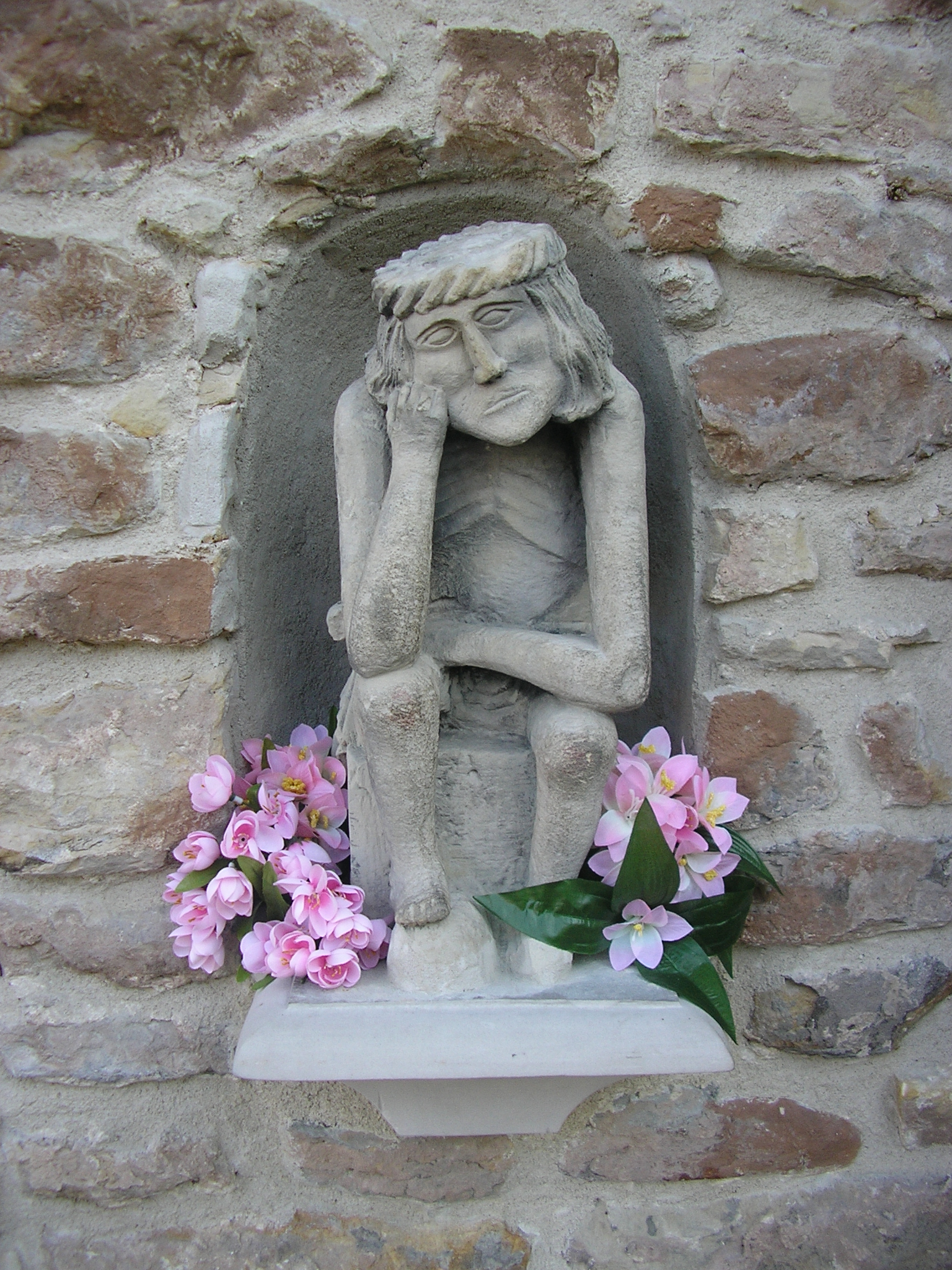
Perhaps this figure's posture provides clues. Take this rectangle, short ends top and bottom, and turn it on its right side. The figure is no longer fetal, rather, he is seated, with his head rested on his hands. Anyone familiar with Polish or neighboring Lithuanian folk art can tell you: this is the posture of the Worried Christ. "Chrystus Frasobliwy," variously translated as "Worried Christ," "Sorrowful Christ" or "Man of Sorrows," is the most frequently encountered male figure in Polish folk art. It can be found in roadside shrines and folk art shops, in several media such as wood, stone, or metal. Worried Christ shows Jesus at some point in his Passion, perhaps after being whipped. He is typically wearing a crown of thorns and a loincloth. He is seated, his head resting in his hands. He is weighed down by the weight of his suffering and his destiny, and yet the Worried Christ, his center of gravity low, is not without strength and dignity. This is a Christ who has been beaten, but who is not beaten. He wears his scars, even his humiliation, as a gravity that binds him closer to the powers of earth. He has been stripped of any distraction, any of the "unbearable lightness of being," as Czech novelist Milan Kundera put it in the title of his best-known work. No stray wind will blow him off course. His pose is meditative; it may be his own suffering that obsesses him, but, given the look of transcendent thought on his face, it may be experience itself. The seeker does not feel foolish coming to this semi-naked, whipped outcast to plead for intervention, does not feel selfish presenting personal woes to someone who so obviously has suffered himself.

The human form in "Falling Star" is not a Worried Christ. He wears no crown of thorns or loincloth; he is lying rather than seated. This form is, though, part of a tradition in which stoic inaction in the face of cataclysm has been represented as honorable, even mysteriously powerful. The tradition of the Worried Christ must be considered when assessing "Falling Star."

And so I look at it again. I have reported my speculations; I am "conclusion-free." This artwork rewards me at least partly because it contains enough data to inspire in me a bit of the sense of mystery I know when I ponder the night sky, or experience itself, and, like the night sky, like life, it provides me with no more data than that, certainly not enough to understand what anything means.

I selected this artwork as an entrée into Polish folk art and its wider culture not because it contains elements of folk art, although it does, for example, the arched, painted wood typical of an altar triptych, or a figure that may be compared to a puppet or to a Worried Christ, but because it symbolizes for me Polish artists, and the wider population there, and in all of Eastern Europe. Life anywhere is precarious and unpredictable; the precariousness of life seems underlined in Eastern Europe. Overwhelming and mysterious energies charge forward without let up: war upon war, the mass displacement of immigration, Nazism, communism, environmental catastrophe. The viewer questions: "Is this annihilation or spiritual opportunity?" No definitive statement has been formulated as yet. However, we have the art as testimony to what people can do, even with fire aimed at their hearts.

Friday, April 13, 2012

Bright Sun Shiny Day


Spring isn't just flirting with us anymore. It's here to stay for it's season. Daffodils, lungwort and hyacinth are blooming in my garden and the dandelions are coming out with a cheerful hello.  

I wanted to post some pictures of Pisanki given that many of us celebrated Easter, Passover and spring this past weekend. I bought this decorated egg in Poland last summer. I love pisanki: the symbolism, the colors, the decorations, the act of making them. The egg has symbolized for many, many, many years, fertility and the revival of nature.  In Poland and elsewhere "Christianity imbued the painted egg with new meanings transforming it into the Easter egg and giving it a new symbolism but it could not totally eradicate the elements of pagan beliefs associated with the painted egg. Easter eggs, blessed in church by a priest, were continued to be used as a sort of charm for many different occasions: to be placed under the corner stone of a house; to help making bees to give more honey; to guard against misadventure on a journey; to secure happiness in marriage; to promote multiplication in the animal, floral and human worlds, to a name but a few of its functions."(http://www.ppld.co.uk/en/easter_pisanki.htm)

Usually between Easter and May Day a group of friends and I get together to make this style of egg together. I hope we do it this year as I have a lot of inspiration from my trip last summer.


I was in Pennsylvania last weekend to celebrate Passover and Easter and visit with our immediate family. It was a quick trip but so nice, ...especially nice to spend a bit of time with our families. Spring is ahead of us by a few weeks down there and it was a treat to "time travel" through the season. I like to think of it as time travel anyway because I get a tease of what's to come then get to head home, north to the cooler hills, and watch the whole thing unfurl slowly before my eyes.

Travel seems to take it out of me a bit more nowadays but I'm back in my groove and heading down the home stretch towards a goal of having a bunch of new merchandise (cards and prints) for a spring festival on May 12th. I also plan on updating my Etsy shop, blog and will have my promotional and marketing materials written up and posted. Actually, I have a lot to share with you in the coming weeks as I take it up another level. I'll begin a portfolio page here with my blog of projects I've been working on. I was commissioned to design a tattoo and and will be posting about that. My art now lives on a human body! Wow, now that is something permanent. I'm also putting the finishing touches on a wedding invitation I was commissioned to design. I can't wait to share these projects with you!

I just started an online course this week called Creative Courage which is offered by a lovely artist named Stephanie Levy. I'm hoping to continually learn tricks of the trade especially in relation to starting my own home business and balancing my creative life with being a new mom. So far this week has been full of good writing exercises, reading and interviews with inspiring creative women.

I hope you all are enjoying spring in your own way and feeling the energy of new life and new inspiration during this beautiful season.

Thursday, February 23, 2012

Revisiting Summer...in Poland


This morning I got out of the shower and was surprised to see how the house was darker than when I woke up! The gloom and impending rain inspired me to share some beautiful photographs with you from a sunny, summer day spent at a Skansen (Open Air Museum) in Poland last August.

Come with me to re-visit this Skansen in Tokarnia nearby the bigger city of Kielce, Poland. An old world village atmosphere is created with regional architecture, old & well maintained peasant homes: many white washed with thatched roofs, lively & colorful cottage gardens, a wooden church with hand painted interior, wooden sculptures by a folk wood carver/craftsman, altars and crosses marking your journey along the pathways, rural dwelling interiors with, herbs drying in entry ways, masonry cook stoves, embroidered linens, decorations honoring special times of year, ritual and traditions and geraniums in the window sills and paper cut curtains for decoration.

I hope you enjoy this summertime stroll where we'll see many things representing a rich, rural lifestyle and some cultural traditions found in Poland. I love feeling the sense of spirit infusing these places, objects, gardens with beauty, meaning and connection to the land, history and people of this place.

Sunday, January 15, 2012

Polish Posters and the Krzysztof Dydo Collection

- Exhibit of Polish Posters collected by K. Dydo, Instytut Polski, Budapest, Hungary, Aug. 2011

Last winter I was introduced to Polish posters when I took a job at a poster restoration shop called Funnyface Productions, repairing torn paper and touching up color and paint on worn, used and loved collectable posters. Some of the posters struck a chord.  I really admired Polish circus or "Cyrk" posters. I instantly liked their strong, stylized and colorful graphic design.

Soon I was introduced to and became curious about Polish artists' take on cinema. These artists came up with some of the most imaginative, mysterious and artistic movie posters that I have ever seen.  In the U.S. almost all of the movie posters are based around movie stars or scenes from a movie. Polish artists rendered movie posters that were truly creative; an artist's visual inspiration of a film. Besides movie and circus posters I also got a small taste of music, propaganda and political posters. I was left wondering... "What is this all about?"

Skip ahead to Spring 2011... My dream to travel and learn in Poland and Hungary became real as I planned my experience for the summer. Many synchronistic events lined up before I boarded the airplane and once I arrived to my destinations.  

A story of sychronicity:
While in Krakow I wanted to connect with and learn more about Polish posters. On a walk after my art history class I came to a Polish Poster Gallery on ul. Stolarska which is owned and operated by Krzysztof Dydo and Ewa Pabis. It was closed but I made a mental note of it's location and planned to return when it was open and I had more time. I returned a number of days later and spent about 2 hours in the shop looking at the wealth of posters and poster related information there. I introduced myself to and talked with Mr. Dydo, who was friendly and very helpful. I looked at the catalogs and books he put before me as he told me a little bit about his life's work collecting Polish posters and exhibiting them around the world.

- image taken inside Galleria Plakatu, Krakow

How fortuitous is was for me to spend a little bit of one on one time with one of the leading collectors and promoters of this art form. Dydo's collection holds over 30,000 Polish posters, he's exhibited the posters all over Poland and Europe and also in Australia, Mexico, China, Iran, Canada and the USA.  As luck would have it, he shared with me that he currently had an exhibit up in Budapest and it was to still be there when I arrived in Hungary! When I shared with him how I especially like the Cyrk posters he said a man in NYC, a collector and dealer, was asking him to write a book about the Cyrk posters. Dydo shared that the Cyrk posters are not his favorite style poster so for now he is not interested in writing a book. I hope at some point he may change his mind as I'd like to learn more about these posters. It so happens that the man in NYC, asking him to write the book, is the same man we receive posters from in the restoration shop in Haydenville, MA! Small world...  I left the shop happy and full of information after the meaningful time I spent with Mr. Dydo. I bought a copy of one of his books, "The Polish Poster of the 21st Century"
 ...and he gave and sent me away with many leaflets, booklets and postcards relating to Polish posters and exhibitions. Unfortunately this beautiful book never made it to my house in the USA. The box that I shipped from Poland, containing many books, broke open somewhere, somehow, once it arrived to one of the USPS processing facilities. This was a big disappointment as I was hoping to spend more time with the book looking and learning. I wanted to share it with the people I work with at the restoration shop. Also, Dydo himself had signed it for me.

While in Budapest I went to the Polish poster exhibit on one of my last days in town. Here is the street and the location at the Instytut Polski...


Inside the exhibition room a large wall was hung almost floor to ceiling with Polish Posters. A feast for the eyes in their proximity and diversity.


I still have an awful lot to learn about Polish posters. I found a wonderful and informative article on line by Andrea Austoni called "The Legacy of Polish Poster Design". Austoni shares with us the history of the Polish poster from it's birth in the 1890's to how the posters exist nowadays. Most interesting to me is how the Polish poster is such an important contribution to the Polish national art form. Poland's history as a 'non-existent' country in the late 19th century, to it's sovereignty and independence between WWI and WWII, after WWII when Poland found itself under communist rule, and now to Poland's independence the poster often was expressive above and beyond it's role as an advertisement.

In the 1950's, although Poland was still under communist rule, in the creation of posters artists had the freedom to be most creatively expressive. Austoni says this,

"The fierce Stalinist rule had been lifted, once again leaving room for artistic expression. The classic works were created in the next ten years. Three important remarks must be made. First, at the time the poster was basically the only allowed form of individual artistic expression.
Second, the state wasn’t concerned much with how the posters looked. Third, the fact that the industry was state-controlled turned out to be a blessing in disguise: working outside the commercial constraints of a capitalist economy, the artists could fully express their potential. They had no other choice but to become professional poster designers and that’s why they devoted themselves so thoroughly to this art."

I believe that this is why we find so much passion, imaginativeness and expression in Polish posters. For awhile this form is where artists could most express themselves. An identity, a national identity, is infused within the images and graphics of the posters even when what is being promoted is a Fellini film or jazz music.

Please visit the links embedded in this blog entry if you'd like to learn more about Polish posters. There is a wealth of information out there. Austoni has a number of good links at the end of "The Legacy of Polish Poster Design".

(Images of posters taken at Funnyface Productions, Galleria Plakatu and Instytut Polski)