Wednesday, August 3, 2011

Peasant Art and the Natural World as Inspriation: Wyspianski

I've have a lot on my mind. Clear thoughts seem to pop up most often when I am taking walks around the city. While in motion, I have the most clarity...always. This is the case when I walk and garden. Perhaps I need to carry a recording device with me because a computer or journal just doesn't cut it...too much movement and too much dirt. I get back to my room, the computer, my journal... What were those thoughts? I try and retrace steps in my brain. 

One of the topics that has a lot of circulation around my neuropathways is Polish peasant art, folk art, making sense of it, the expressions and the context for expression. Who did what? Why? What were/are folk artists drawing from? What was the their world like while they were making art? Who has drawn from peasant art in different art historical periods for inspiration? Who is drawing inspirations from it today?

Obviously I have a lot of questions (and this isn't even all of them). So many that one of my contacts at the Ethnographic Museum, after emailing her a few questions said, "All your questions and topics are very interesting but cover extremely wide field of knowledge. It is nearly program of 3 years university studies of ethnology or cultural anthropology. If I’d like to answer one of  the topics or even try to talk about, it would take a lot of time. May be you would consider ethnology studies?" Hmmmm.... She was very gracious and about to head out on her holiday so she pointed me to a number of good books in english. She offered for me to read in the museum's library which was open for three mornings before it closed for renovations for the summer. I went, I read. She's right, my questions are going to take study, reading and a good amount of time to answer.

An artist who I have been learning about here in Poland and am drawn to is Stanislaw Wyspianski. I'd like to write about him because of my attraction to his work and the fact that back in the late 1800's early 1900's he was drawing from Polish peasant art and it was most definitely influencing his creative output. I'm so impressed with his work, his life, his vision. He strikes me as a Polish renaissance man, a "Leonardo Davinci". His life ended way too prematurely at age 38. What he was able to accomplish is amazing. He was a playwright, a painter, a poet, a stained glass window designer, a furniture and interior designer, he designed his theater sets and costumes... He was also a non-conformist and shook things up. He looked to the past as inspiration and brought it to the present. He brought Polish peasant art and romanticism to his work yet in a modern and new way. He regularly drew on this inspiration as a theme. He was connected to the natural world which is evident in his studies of flowers and plants. He also drew patterns which evoke patterns found on Peasant costume.  One of his most well know works is a play called "Wesele" (The Wedding Party) which addresses class ( peasants verses the upper class) in Polish society in the 19th century. I have yet to read or see this drama but it is high on my list to familiarize myself with upon my return to the states. I think it is available to see as a film too. He married a peasant woman which created quite a stir in the upper class, intelligentsia he came from...  Wyspianski is one of the most important Polish artists. I like him all the better because he expressed his sense of identity, Polish identity, and consistently referenced the authentic, honest, earthy, yet spiritual peasant art and culture to express himself.  I believe this was especially important as he created his work during the Polish Partitions when Poland was not even a unified country.  Polish peasant art and artist's like Wyspianski helped keep the Polish national identity alive during the 123 years when Poland did not exist as a country.  This reality further proves my feeling that the artist's job is to express the heart and soul of humanity, of a place and of spirit.


The following pictures are paintings by Wyspianski and photographs that I took from the museum that honors him and his work and from Krakow's Franciscan Church where he designed the decorative flower motifs on the walls expressing the Franciscan's love of nature. He also designed the beautiful stained glass in this church as well. It is my favorite stained glass in Krakow. The image of God the Father emerging from chaos is captivating with it's organic shapes, lines and bold colors...drawing from Art Nouveau. I hope you enjoy seeing some his work as much as I do!


Self Portrait with Wife at the Window, 1904

 A snowflake interior lighting design by S.W....

Planty Park at Dawn, 1894   ...this is a scene right from the beautiful green belt surrounding Krakow Center

Stained Glass, Franciscan Church, Krakow

Floral Motifs, Franciscan Church, Krakow


Stained Glass, Franciscan Church, Krakow

God the Father, emerging from chaos...Stained Glass, Franciscan Church, Krakow


Monday, August 1, 2011

Haunting and Thriving... Kazimierz


I am continually finding myself down in Kazimierz, a distinct neighborhood in Krakow. Of course it has to do with the fact that the Ethnographic Museum is located here but there is something else... A haunting and a vibrant quality resonates around and within this place, most likely because of it's rich and intense history.

This part of Krakow was founded by Kazimierz the Great in 1335 and was built with it's own wall, two distinct churches, town hall and plans for a university. Kazimierz became even more distinct and separate in it's feel when in the late 15th century the king moved Krakow's Jewish population here. It was a thriving center of Jewish culture for many, many years where there was relatively peaceful coexistence of the Jewish and Polish people. Synagogues, churches, Jewish cemeteries, historic buildings, narrow streets lined with buildings showing their age and character, cobblestone streets and squares mark this place with a solid character and feel. Please read about Kazimierz on Wikipedia if you are interested in it's history.

Kazimierz is haunting. Perhaps it's a haunted place? I sense people who are long gone and events that took place here. There is an echo of intense sadness vibrating from empty buildings, stone walls, rebuilt synagogues, narrow cobblestone streets. However, alongside and touching this haunting is vitality. There is a  quality of time moving on and people moving forward with fresh, healing energy. Does Kazimierz have a dualistic nature? These two qualities, hand in hand, are bound together in my sense of this place.

I also feel confusion, disgust and mourning about the years of terror during the Nazi occupation of Krakow for about 5 and 1/2 years between 1939 and 1945 when the Polish and the Jewish populations were brutally terrorized. I went to Oskar Schindler's Enamel Factory, which is now a permanent exhibition called "Krakow Under Nazi Occupation, 1939-1945", were I was overwhelmed with tons of information describing  the intense history of this time... where both horror and humanity were expressed.  Erased lives, families that were torn apart, hate, discrimination, murder, destruction... all this is palpable. So is the reality that some survived and risked their lives to aid in the survival of others.
A sense of this time infuses Kazimierz even today. What was once a thriving Jewish center is a fraction of what it was. Prior to WWII Krakow was home to thousands and thousands (60,000 -70,000) of active Jewish people. One feels the ghosts of this kind of cultural and religious presence. Now the Jewish population is small but thriving. Synagogues have been rebuilt, museums and educational materials share the intense stories, Jewish religious observations are taking place, cafes, shops and live music bring vitality, energy and awareness back. Perhaps healing is happening here? Time is moving on.

Many people live in Kazimierz now. It is home to a thriving and very cool cafe scene. Cafes serve coffee, tea, wine, beer and alcohol. Spaces, rooms...one leading to another, filled with vases of colorful flowers, art work on the walls, dripping wax candles gracing every table, nook and cranny along the bars and walls, outdoor garden space to sit, talk and sip a drink. I could do a blog post just about these wonderful places and spaces. Art galleries line streets, studios, restaurants... colorful signs and atmosphere. Kazimierz has a bohemian feel which is infusing this place with fresh beauty and vitality.

The pictures shared with this post were taken over a few days... there are photographs of street scenes, a synagogue, buildings, a museum display celebrating American-Jewish music, spaces that were featured in Spielberg's movie, "Schindler's List", artistic spaces, places with history...

Friday, July 29, 2011

Six Senses Friday: Krakow IV

This past Wednesday I spent an hour or so at an open air market, Stary Kleparz, in Krakow where there is an abundance of fresh produce, cheese, sausages, meat, bread and baked goods, clothing and household items. When I'm in places like this I can't help but get out my camera and take photos of the cornucopia of abundance, beautiful color combinations and textures mingling in piles on tables and being presented in windows. I thought I'd share photos from the market with you as I post my weekly "Six Senses" update.
SEE:
- I had the wonderful opportunity to meet more of my relatives in Korczyna last Sunday.
- a small bouquet of flowers adding color to my dorm room, picked from my relatives gardens...three zinnias and a rose
- ancient symbols and motifs found on very old architectural and archeological items ... and the thread of these symbols in Polish peasant art
- I walked around the Jan Matejko Fine Arts Academy on a quiet morning among the sculptures and sculptural casts and sensed the energy of artists who studied and created in that building.
HEAR:
- Polish being spoken all around me at the table in my cousin's home while Lukasz tries to keep up with the translating.
- an evening of live music played by  Kwartet Jorgi (a polish band with roots elements) a bag pipe like instrument, wooden flutes played along side a tenor sax, acoustic guitar and hand percussion... hearing dissonant harmonies and a lot of improvisational elements
- my 8 year old cousin, Marta, quietly humming Leonard Cohen's song, "Hallelujah" as we took in the view from atop Mt. Tarnica
- strong wind blowing, humming and resonating against and through a metal cross on the top of Mt. Tarnica
SMELL:
- fresh mountain air
- wildflowers in blossom as honey bees busy themselves with their work
- a warm kitchen filled with scents of delicious, cooking food
- the fruity and sweet bouquet of my cousin Roman's homemade wine
- a cigarette being smoked inside a cafe at night
TASTE:
- Cousin Roman's delicious homemade wine
- Cousin Paulina's fresh, delicious homemade doughnuts
- Warm beer with ginger and clove on a cool rainy night in Cafe Camelot
- Cousin Kinga's homemade kremówka papieska a cream cake/pastry which was apparently Pope John Paul the II's favorite Polish pastry
- strawberries on white rice with fresh sweet cream poured on top
TOUCH:
- kissing cheeks and exchanging warm hugs with my growing family
- running my hand over tall grasses with full seed heads as I hike up Tarnica
- pen to paper as I begin to sketch designs found on Pisanka eggs at the Ethnographic Museum
- the petals of a freshly cut rose
FEEL:
- sadness at the sense of closing as my program at Jagiellonian University winds up... classes are ending and new friends and acquaintances are leaving
- very interested in the language of symbols
- tired of the cool, gray, rainy days
- tipsy after an evening of visiting and talking over lots beer and pizza at Cousin Paulina's and Lukasz's flat
- pleasantly overwhelmed by the generosity and warmth of my family here in Poland and also by my family and friends at home who have been so supportive and enthusiastic about me coming here to Poland this summer
- like I am learning so much about Poland, the culture, the country, society...  Poland is such a complex, beautiful and complicated place with such a rich and at times very painful history. I hope to do some more writing here on my blog to share with you my deeper sense of this place.

Monday, July 25, 2011

Hiking Tarnica

I arise today
through the strength of heaven, light of sun,
Radiance of moon,
Splendor of fire,
Speed of lightening,
Swiftness of wind,
Depth of sea,
Stability of earth,
Firmness of rock.
-Celtic Prayer


I spent this past weekend in the good company of my cousin and his family in Korczyna. On Saturday he took me, his wife and his daughter to one of his favorite places, a mountain hike in the Bieszczady Mountains up a peak called Tarnicia which is located at the most southeastern point of Poland, bordered by the Ukraine and Slovakia. 

The place, the wind, the flowers, the rocks, the trees, the sky, the clouds, the grass, the wild... and my body moving amongst these elements, as we hiked up and down the mountain, created within me such a positive feeling. My heart kept a strong rhythm in pace with my footsteps: a drum within me, musically passing the moments of this dance of the outer and inner.

Friday, July 22, 2011

Six Senses Friday: Krakow III

* The images I am posting this week are reflective of a more contemporary Krakow. City streets, apartment buildings with balconies full of geraniums, surrounded by green walkways and parks, Communist era architecture, views of the river... Like I've been saying Krakow has many historic, beautiful and nostalgic sites while the contemporary world exist right along side.*

SEE:
- a crane or stork landing in a field surrounded by warm, end of the day light
- a man on his tractor, mowing hay with a little boy on his lap, on a green, hilly field
- Stanislaw Wispianski's art work in the museum dedicated to him...it resonates with me.
- lightening flashing through a steel gray sky
- a young couple on a bus ride, falling in love
- Polish film, "Man of Marble" (1977), by Andrzej Wajda, dealing with the complexity of Communist era Poland. "The director communicates two opposing truth's: First, that Stallinism was a disaster and second, that the people who believed in it- and whom it consequently crushed- were driven by an honest spirit of idealism."


HEAR:
- Alexander's album "Alexander" has become my musical soundtrack (obsession) this month. I listen to it almost every day. Thank you, Beth Marie and Digger!
- young adults in my dorm partying at the outdoor bar not far from my room's window
- a cheering crowd at a nearby stadium
- gentle, rhythmic rain falling 


SMELL:
- freshly cut lavender
- dark bitter, sweet chocolate
- the scent of perfume on people as I ride the trams
- smoked sheep and cows milk cheese I bought and ate from Zakopane, made in a beautiful, decorative mold 
 

TASTE:
- the best, thick hot chocolate I've ever had with fresh whipped cream.
- the cafeteria food is no longer interesting me
- Apple cake and tea at an authentic and original Art Nouveau cafe, Michlik's Pastry Shop, "Zielony Balonik"...(The Green Balloon)
- herbed vodka while sitting at a rooftop table along the Vistula River, watching the sun go down


TOUCH:
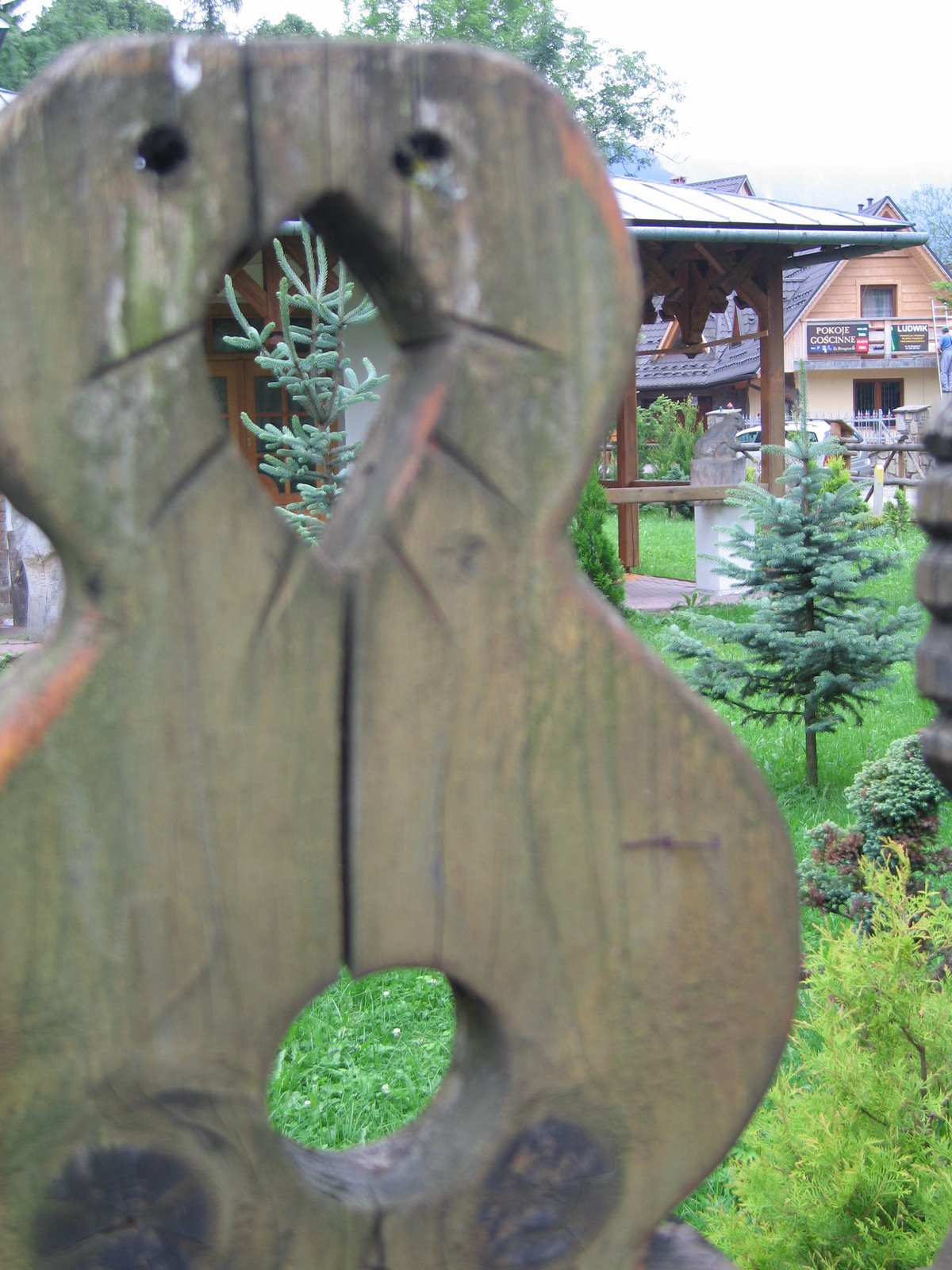
- an ornamentaly carved wooden fence post outside a Zakopane building
- prickly grass against my bare legs as I sit in the sun, reading along the river
- picking up a handful of lavender after it was trimmed at a city park and rubbing it between my fingers to release it's sent
- velvety orange-blushed apricot skin before I eat the fruit


FEEL:
- inspired by the decorative wood work in Zakopane
- very supported by my family, professors, and the people I've met at the Ethnographic Museum. Everyone has been so gracious and helpful. I hope to give back to them and to others the way they have given to me...
- very curious
- thoughtful and reflective
- the stirring and push of change as my time in Poland saturates me with new experiences, information, artistic, cultural and social perspectives.