Wednesday, February 27, 2013

Phoenix


A highlight of this gray and snowy February was visiting Mass MoCA for the art museum’s free day a few weeks ago. After packing the car with baby and stroller we drove off through the hills of western MA to North Adams the day after we got 17 inches of white, powdery snow. What a beautiful drive! The wheels of the car were hushed as they turned on top of a packed layer of snow on the streets while sun shone down on pure white, reflecting sparkles like crystals.

The most beautiful and interesting piece of art of the day was Xu Bing’s Phoenix installation. This is the kind of creation that makes your jaw drop in wonder as you enter the huge space and catch your first glimpse of the two Phoenixes. Masses of metal and bamboo - construction and building debris from building sites in Beijing - defy logic, suspended in the air from the ceiling as if flying. Rubbish is arranged artfully and becomes poetry: beautiful and harmonious. The two phoenixes are almost 100 feet long and weigh over 20 tons in all.

Originally the works were commissioned by a real estate developer for a glass atrium connecting two World Financial Towers in Beijing. While visiting the site the artist was impacted by the contrast between the raw, gritty realities of the laborers and their living and working conditions and the building's splendor and opulence. This reality reflects the truth of two worlds living side by side in Chinese society. Wealth and excess contrasts with the stark and gritty.

One of the things I find particularly interesting about this work is it’s connection to the creation of a societies folk art: everyday people creating works of meaning with materials that are at hand. 

Xu Bing uses found materials at the construction site and builds the sculptures with the migrant laborers, the same laborers responsible for the growing skyline in Beijing.  His muse is the mythical symbol of the male and female phoenix.

“...this multifaceted symbol which has signified a multitued of meanings throughout history, from imperial power and wealth, to prosperity, fertility and eternity, The artist was particularly attracted to an image of the phoenix from the Han Dynasty, when the bird was often featured in male/female pairs like those now suspended from MASS MoCA’s beams. Steel rebar, girders, bamboo, scaffolding, conduit, shovels, hard hats, gloves and other evidence of labor (demolition) form the body, feathers and talons of Xu’s interpretation of these mythical birds. The heads of both the male Feng and the female Huang are made from the nose of an industrial jack hammers, a contemporary translation of their strength and ferocity (historical images of the phoenix often show the powerful bird with a snake in its talons or beak).

As an image, Xu’s birds are a potent comment on wealth and excess - and also on the progress of modern society and the debris often left in the wake of progress.”
(- MASS MoCA, text by Susan Cross)

I'm always especially interested in a creation when it's connected to folk art traditions. Something pure happens when the playing ground is level and art is made for something other than the enjoyment of the elite.

I was only able to take a couple pictures before my camera’s battery ran out. One is the header to this blog entry and the other follows...


 I found these images to share online:


I wish I saw the sculptures lit up at night with the LED lights that outline these pieces. I might try and get back to the museum to see this before the exhibit travels on down to NYC. I believe the next place it will inhabit is a cathedral! I'd like to see that too!

Saturday, January 12, 2013

A conversation about art and other good stuff between Jack White and Conan O'Brian


I spent some down time yesterday listening to this conversation between Jack White and Conan O'Brian who are both bright, talented and who excel at their crafts.  I love an opportunity to learn from the masters and was interested to hear what these fellas had to say about the creative process.  It's a long conversation but something you can have on in the background as you do the dishes. Sitting down with their drinks, this is more a conversation between friends, comfortable and joking around, than an interview. I appreciate how candid and vulnerable they are with each other and their thoughts. It doesn't matter if you are a musician, a comedian, a painter, a writer, or for that matter, anyone trying to bring something to life and share it with others, there are universal truths and connections here for all of us who are creating something. Topics of conversation include back and forth dialog about work, talent, vision, authenticity, success, women, religion, the performer/audience relationship, Bob Dylan, upholstery and the number three.

I bought the newest album, Blunderbuss, by Jack White in July on my first outing with Kaz a couple weeks after he was born. It's been played on regular rotation in my car and it really is a good record. This is my favorite song on the album more for the sound then the lyrics. A great saloon style piano meandering around loud electric guitars with cool chord progressions. And a guitar solo only as Jack White could play it, edgy and loud ... Love it!  Go ahead and have listen...


Thursday, December 20, 2012

Winter Solstice


It's solstice already. The dark, cold, quiet time. In moments I'm met with an extreme sense of well being. Like when I'm driving over a hill, heading west at sundown and get to see the layers of clouds exhibiting many shades of gray with pastel colors illuminating them from beneath as the sun tucks itself in beyond the horizon. Tonight I had such a moment of quiet in the car, looking at the play of colors in the clouds and imagined sitting down to work it out with my water colors. Another time is when I stoke the fire in the wood stove and the logs light up cheerfully with bright flames providing a flickering dance to look at and cozy warmth to sit in front of with Kazmir and play. I've been listening to classical music a lot lately, the local public radio station in the car and using my Spotify account to listen to all kinds of interesting instrumental and vocal music. Russian folk guitar and the singing of Anonymous Four, their Wolcum Yule album, has been played a lot these past days. This stuff fits my mood perfectly. I need quiet, reflective music,  nothing too cheery or upbeat, something soul soothing and beautiful. Perhaps its my solace in this time of constant care giving. Giving all I have to another being and living by my son's schedule. I need soothing. I also need soothing in this time of hard realities in the world.

In my head, I've been thinking and dreaming about things I want to do. Things I'd like to make time for in my life. It's that time of year too. Time to reflect and make plans for the year ahead. I feel like I may be ready to begin my "independent studies" again soon. I just need to organize myself and my things so that it is easy to work on what I want to work on when I have a brief window of time. I just don't have a lot of open ended time. I get an hour here and an hour there and then there is the evening hours which are often still punctuated by Kaz's stirrings and need to nurse as he settles down for the night. I'm not good at working with interruptions or with clutter around. I need clarity around me so that I can think clearly. So I'll just have to do my best in this new reality. I do not want to stop working on what I was working on before the baby arrived. I want to pursue my dreams and passions and also be an example for Kaz so he can grow up witnessing adults around him following their dreams. I got an interesting email today from a man who found my blog by looking for information for the village of his ancestors which happens to be the same village where my Hungarian ancestors lived. This email got me to look back at my blog and read the post he found. I also read other posts from my trip in the summer or 2011. Wow! What a trip. Was that really me? I'm in such a different place now but still I know all that experience lives inside me. There is a lot more desire and longing for connection, understanding and learning in these areas of interest...folk culture, eastern Europe, art making and family....  I think it's time to start making baby steps in that direction again and hopefully some momentum will build and I will be able to move forward on dreams that are important to me.

Speaking of the holidays and dreams I will spend Christmas in Krakow someday. I just saw this link, an article on CNN"s travel page about Krakow at Christmastime, made by someone on Facebook and it totally touches on my longing to get back to Krakow....Old town center, Christmas Market, mulled wine. Time to really start my Polish language tapes in earnest.

On another note, it has been an exciting couple of months in that I've had my art work up at the Meekins Library in Williamsburg MA for November and December. It's been a very successful show and have gotten nice feedback, sold a few prints and lots of cards and may have gotten a commission to make paper cuts for a lampshade. My cards have been selling well in the handful of places I have them. That feels good too and I look forward to spending more time organizing and working on my design business this winter into next year.

Finally I want to wish you a happy and healthy holiday season and close to 2012. I wish you all many blessings and much love in 2013! To take us out, a picture of Kaz similar to what I chose to use for our holiday card this year. He's the best part of 2012 for us! His arrival has been a source of great joy. xoxo


Friday, October 19, 2012

October


October is drawing to it's end and time continues moving it's swift pace. The season of fertile summer, flowers, babies, green leaves, warm days is very much behind us as I take a deep breath and begin to catch up with my life. For me, since June, it's been the season of "baby".  For awhile I barely attended to what I would normally be doing in the summer and early autumn.  The feeling of newness and unfamiliarity is shifting into another state. Kaz, Josh and I have really become a unit and now the new normal is settling in. Some routines have been established and still there is a lot that keeps us on our toes. I imagine that raising children keeps you on your toes at all stages, so here we are. Yet despite this awesome focus of most my attention, some attention is being refocused back on me and my pursuits.....ahhhh....art...gardens...writing.

We have a new home studio/office that we built last spring.  As I sit here typing the rain falls, I look out the new, big picture window and I notice that most of the leaves are off the trees. The beech trees are the last to shed their leaves in our woods and I can see their green, yellow hue mixed in with the newly exposed greys and browns of bark and branches. I love when once again I can see the skeletons of trees and the space around us in the new way. We have a western view of the hills across from us, once the leaves are gone, where it is nice to watch the sun set.

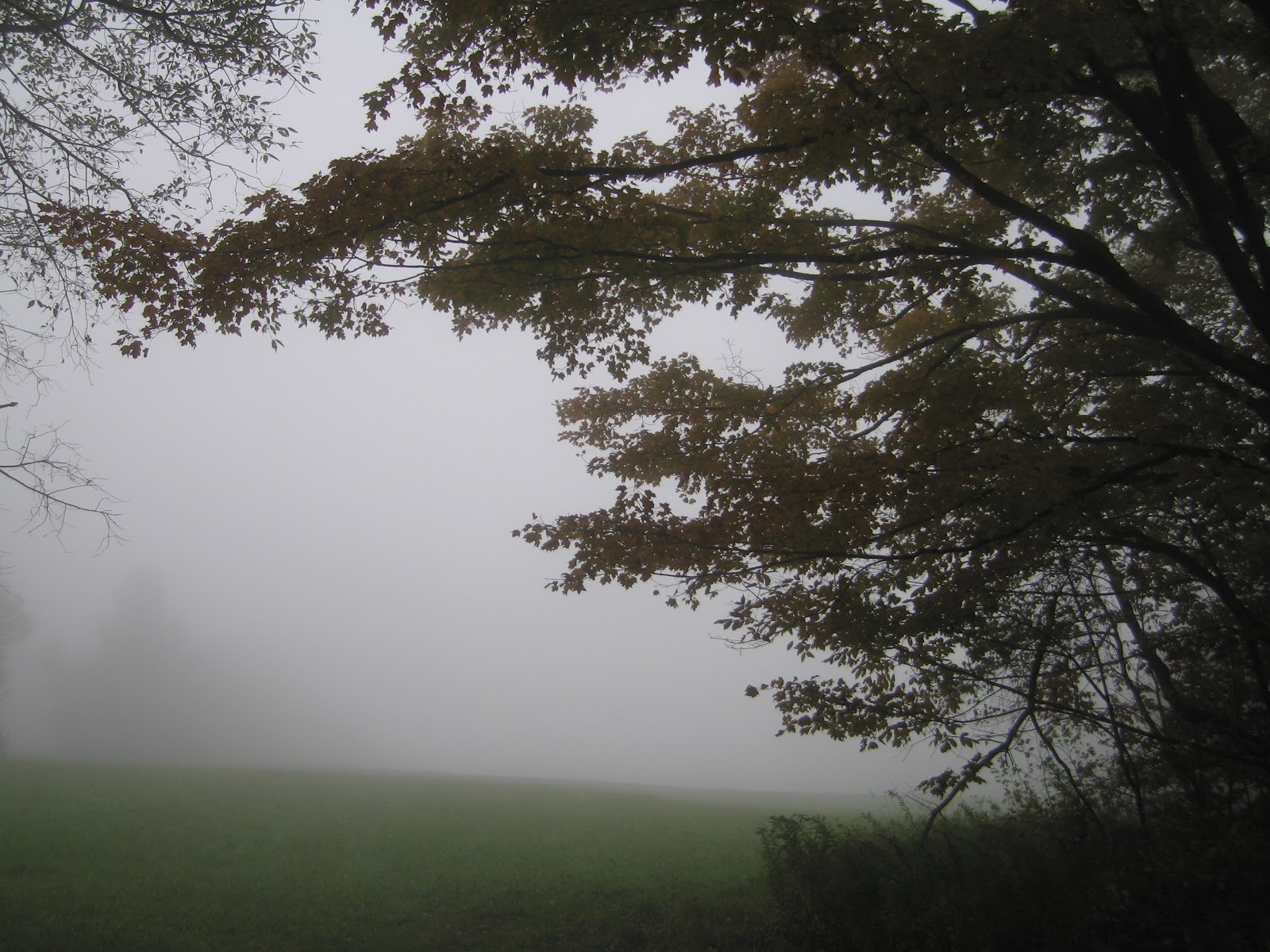
Kaz and I took a couple drives in the last few weeks and I brought my camera along to take some photos. It's lovely and mysterious when the mists and fog cling to the hills and trees this time of year creating mystery and reflecting this time of dying.  The killing frost came letting me know it's time to put the gardens to bed. On a chilly rainy, night last week my beloved feline friend, Gilligan died. This loss magnifies the autumn feeling as I deal with my grief and loneliness for a dear being who touched me so deeply. I will post more on Gilligan in the near future as he shared a rich meaningful life with us and I have some good stories to share. Everything has it's season. There are many old cemeteries tucked away on dirt roads in the towns where I live. I love visiting them from time to time and reading all the names of people who were here before.  Good old fashioned names appear like Ebenezer, Josiah, Hannah...


Next to the Streeter Cemetery on Old Stage Road some cows wandered over to the stone wall and seemed curious as to what I was doing. I explained that I just wanted to take a few pictures as they posed for their cow portrait.

Finally, I can't end this post with out a picture of Kazmir and I in our warm, wooly sweaters, snuggling up at the Ashfield Fall Festival.

Friday, August 17, 2012

Seven Weeks of Kazmir

It's been a little over two months since I last wrote a post. On the home front, we were finishing up a studio/office building project during my third trimester and that took what little attention and energy I had. Then I gave birth to our baby. Good reasons to take a hiatus, but I have missed writing and posting. I hope to get back to the blog on a more regular basis yet time and what I am able to accomplish has taken on whole new dimensions now that I'm caring for a little person.

I return a changed person. I feel fundamentally different to the core in one of the most miraculous of ways. I've gone through an initiation and have begun my life as a mom. Not only was my son born on that special June morning, I feel that I was reborn with him. There was an unforgettable moment during his birth towards the end of the eleventh hour when I was in the water birth tub. I stood up to position myself for a mighty push to move us along. As the contraction came and grew in intensity I had a feeling I may pass out. Instead, I closed my eyes, pushed, and a flash of white light, like lightening, seared through my body and overtook my being. My physical body seemed to disappear into the sensation and for an instant my baby and I were a bolt of lightening, pure energy, transforming, working and moving towards our new life.

Transformation.

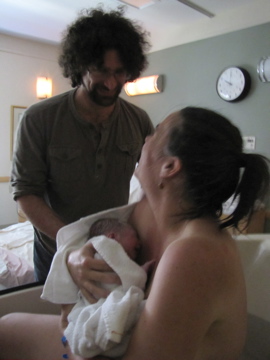
His birth was many things to me, a collection of beautiful and intense moments that I feel blessed to have had the opportunity to experience. I had a natural, unmedicated birth like I had hoped with wonderful care from my midwife, doula, nurse and Josh, who was the perfect birthing partner. Best of all a beautiful, healthy, sweet, little boy arrived in our arms at 9:58am on June 29th ...all 7lbs 2.4 ounces of him. We joyfully welcomed Kazmir Bernard Wachtel to the world.

Happy Birthday!

It's hard to believe that he has been with us for almost 7 weeks. A few people have said to me, "Doesn't it feel like he has always been with you?" Yes. It does. He fits right in and it feels natural that the pure love we feel and interest we have for his care are almost all consuming. And this is perfectly ok. Infants need this love and attention. Already, I can see that this time will fly by and soon I will wonder at how fast he has grown up.  There are sleepless moments, crying spells, fussiness, dirty diapers and brief longings for quiet moments alone to attend to whatever I want but the warm bundle, sweet smile, plump, emerging fat rolls, intoxicating smell, quiet and content nursing moments give the hard moments perspective and make it all totally awesome. Truly, moments of AWE.

How did we chose the name Kazmir Bernard? We like the name for many reasons. Early in the pregnancy it was a name that came up in our conversations that we immediately both liked. Kazmir is a variation of a Polish name, Kazimierz, which means keeping the peace, declares peace. Kazimierz the Great was a 14th century Polish king.  Kazimierz is the name of a historic area in Krakow founded by this king and was a thriving Jewish community from the 14th century until WWII. The name Casimir was in my family as it was my great uncle's name. We think the sound has an exotic feel and evokes Kashmir, the far away, middle eastern land. Kaz's middle name, Bernard, was Josh's grandfather's name. Through his mom and other relatives we had heard such fond, warm memories of a kind, generous man and wanted to honor him in our son's name.

Now, I'd like to introduce you to my little man, Kazmir! The pictures were taken over the last seven weeks. My, look how he's grown! We now lovingly call him "The Tank" due to his 12 lb. solid physique. He is thriving.

First time at the breast

Waking Up

Bath Time

Pondering ...a philosophical moment

Chilling at the Goshen Ocean (photo by Katie Wachtel)
Bright Eyes (photo by Katie Wachtel)

Smiles are shared with us daily! What a thrill. Thank you Aunt Katie for the Rocket Man Onsie.

It's Rocket Man!


Tuesday, June 12, 2012

June Blooms

I think June may be my favorite month in the garden. There is somethings about waking up to the first morning light paired with a particular call of a type of bird in the forest that sweetly sings back and forth to each other as the sun rises. The lengthening days, some cool and some warm, filled with green growth and colorful blooms make me want to go outside and take a look around at least a few times a day. I love where I live. I love all of it's seasons but there is something about June. A kind of calm, comfortable happiness comes over me. Here are some views taken in my garden, a clients garden that I care for and around my neighborhood celebrating this special time.

... a ride through Cummington to a garden I work in...


...some columbine, irises and containers at the garden I care for...


... my husband found a few patches of a wildflower called Lady Slippers in our woods. He took me out there for a walk to show them to me. I'm happy to see that so many special native plants make their home in our woods.


...the roses smell so good in my garden around the house. I think I may look up a rose cordial recipe. I bought a cordial in Krakow last summer that is heavenly...now if I can figure out how to make it myself. That would be nice.


 ...we have many frogs and tadpoles that take up residence in our little pond...

...these Alliums look like fire crackers to me...


...a June view of my front yard garden...


Wednesday, June 6, 2012

All was Fair at the Fair

It was a beautiful, sunny day for the Hilltown Spring Festival on a lovely Saturday in May a few weeks ago. After a winter of work in the studio and two weeks of gathering all the pieces together for my merchandise and table it was a nice to just sit by my wares and know that I pulled my offerings together in a good way to share with an audience and potential buyers. I saw friends and also made some new connections as the day flowed by. I was hoping to have photographs to share of the fair grounds, other activities and basically of the shebang but honestly, I only left the barn where my table was located to use the restroom or to buy a snack, well actually, snacks.  A friend who had a table nearby seemed to take an interest and get a kick out of the collection of snacks I purchased, collected and ate throughout the day. Ah...the joys of pregnancy and eating for two!  I made sure to have kettle corn, Vietnamese beef jerky and sticky rice, and a nice big cup of local ice cream! Oh, and my friend brought over an oatmeal raisin cookie for me which of course I was happy to munch on.

I received pieces of positive feedback about my work and style which was very nice to hear. This energy is charging my batteries for the next push, flurry of activity which will be to list all the new items on my Esty store, make connections with more local stores and begin researching more about my options and finding more opportunities to share and sell my work.

Well my hopes are to accomplish this all but as I write another reality is sapping the juice out of my batteries. My energy reserves seem to be flowing directly to the little person who has taken up residence in my belly. And I'm happy about this.  I only have a month to go until our baby arrives into our arms so the energy is going to a very important and good thing,  towards healthy growth, fat and development for the baby.

I'm happy to finally share with you some news about the festival that happened last month and also share the reality that I'm slowing down...for now.
.

Wednesday, May 9, 2012

Trillium Time


The greens this time of year are my favorites. From the moss on a wet rock beside a stream, to the fuzzy green texture as I look at many different trees leafing out on a wooded hillside in the distance and as I look up at the sky through the emerging leaf canopy. Spring green is so fresh, so unspoiled, so special.  I spent a couple hours in the woods around my house looking this past warm Sunday afternoon. Looking at the green, looking at the water and rocks, and looking for the plants I love to see and visit this time of year. One of my favorite wild native plants is the Trillium.  I found a Trillium island. A rock settled in the stream with a stand of Trillium growing on it. I imagined it is a small fairy like oasis on a big mossy rock, a place I would like to see if I ever shrunk, "Alice-in-Wonderland style", to see and experience from a much smaller perspective.  On the way back to the house I found a place hosting many Jack-in-the Pulpit plants. I bent down to gently lift the lid of the flower and peek inside. Time in nature never ceases to amaze me. The older I get, the more I enjoy it. It feels like every season and every year is a chance to visit old friends and also the chance to see and sense with a newness and freshness. I'm so looking forward to sharing these special places and plants with my child and watching them become aware of how things spiral back around in a familiar, seasonal comforting ways and yet how each year brings a whole new opportunity for fresh perspective, growth and engagement.

Friday, May 4, 2012

As seen at ....Bieganski the Blog: Falling Star - Poland Through One Work of Art

I met the author of this piece, Danusha Goska, in Krakow last summer. A mutual acquaintance introduced us because of our love for and interest in Polish peasant and folk art. Since our time in Poland we have been developing a creative friendship. She is a brilliant writer and professor. She has written and published several books and keeps a powerful, insightful and informative blog about Polish stereotypes and Jewish/Polish relations and dynamics in particular. (Here is the link to this article as it appears on her blog:  Bieganski the Blog: Falling Star - Poland Through One Work of Art:)

Her questioning and thought provoking insights spurred on by a piece of art printed on a postcard is a lesson in itself highlighting the mystery humankind deals with everyday, whether we acknowledge it or not. I now have a broader understanding of Eastern European / Polish thought, politics, aesthetic, psychology and history after reading this blog entry. So, I want to share this interesting piece with you. It is well worth the read.

Danusha has kindly given me permission to re-blog her piece on my blog.  Thank you, Danusha! Feel free to visit her blog if topics like this and more interests you: http://bieganski-the-blog.blogspot.com/


Falling Star - Poland Through One Work of Art
"Spadajaca Gwiazda" "Falling Star" by Witold Masznicz
at the Nicolaus Copernicus Museum in Frombork. 
Source.

"twoj glos dla Solidarnosci krokiem ku wolnosci."
"Your vote for Solidarity is a step toward freedom."
Poster from Krakow, Poland, 1989.
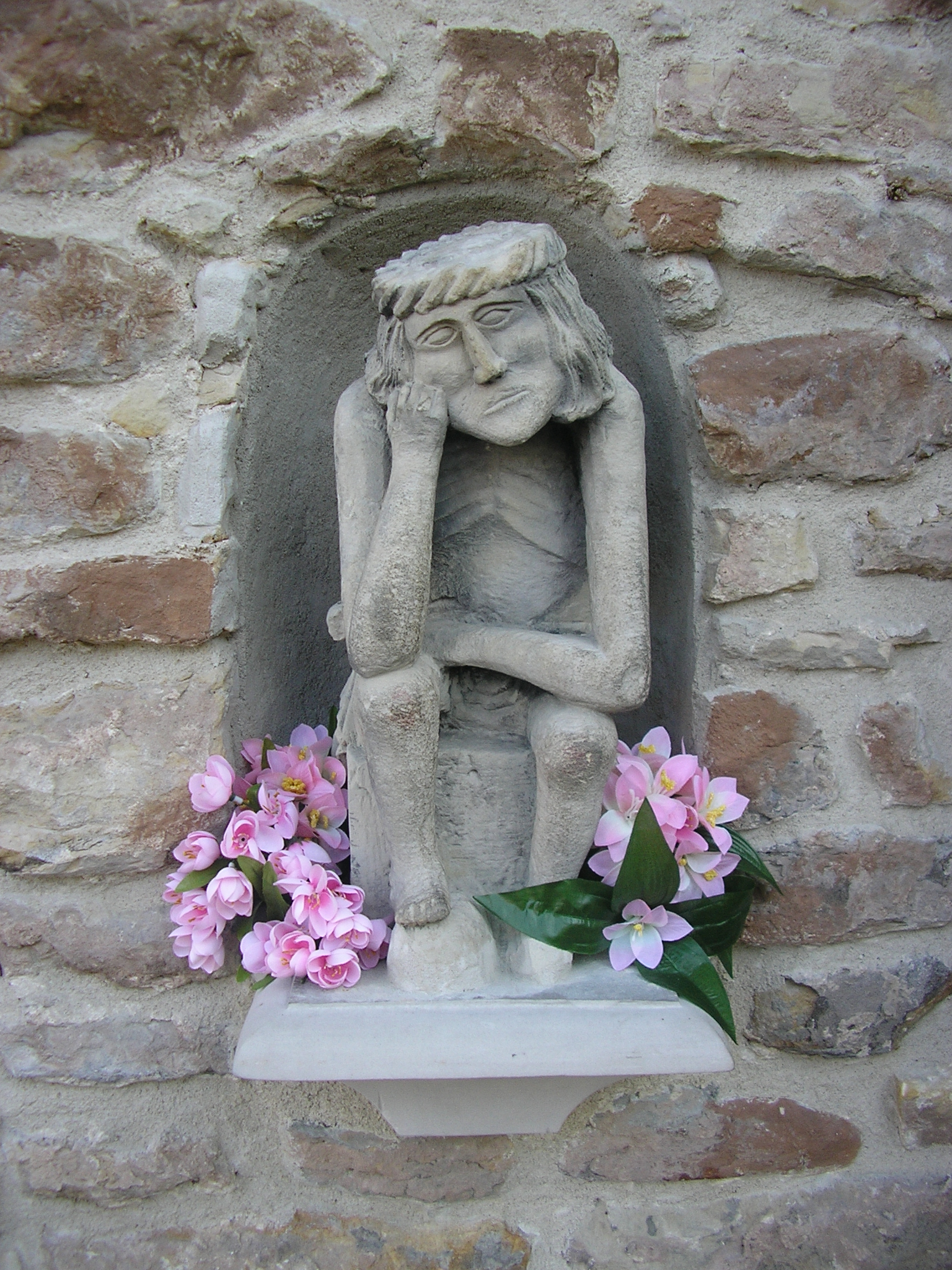
Chrystus Frasobliwy or Worried Christ. Source.
Wood carving by Jozef Lurka. Source.

Below is an early version of an essay that appears in the April 15, 2012 edition of the Journal of American Folklore, volume 125, issue 496. I thank editor James P. Leary for supporting my work. Irish-American Prof. Leary is a champion of scholarship on Polonia. I also thank JAF co-editor Thomas A. DuBois, and JAF editorial assistants Hilary Virtanen and Anne Rue.

As per JAF guidelines, I do not post the finished version of this essay here. I am posting an earlier version. Those wishing to cite this material are advised to access the JAF, available through your library.


On Witold Masznicz's "Spadająca Gwiazda" / "Falling Star"


In the mid-1990's, I took a folk art class with Henry Glassie. Glassie asked his students to select one work of art from a given culture and explain how that artwork offers an entrée into that culture. Glassie gave us free rein; we could select an item of folk, elite or popular art.

I chose to select an artwork from Poland. As a child of immigrants, I had grown up with Eastern European folk art. I'd traveled to Eastern Europe several times, to study, as a tourist, and to live with family. I had lived in Poland for the eventful year of 1988-89, while studying Polish language and culture at Krakow's Jagiellonian University. I would travel to Poland again, to attend a scholarly conference, during my time as a graduate student at IU.

When considering which work of art to use as an entrée into Polish culture, I confronted an embarrassment of riches. I could have chosen a
Góral's, or highlander's, embroidered felt pants; a wycinanka or brilliant paper cutting from Łowicz; one of the szopki or miniature castles and cathedrals hand-crafted from metallic papers and displayed at Christmastime in Kraków. I could have chosen Jan Matejko's painting of Jan Sobieski after his 1683 victory against the Turks at Vienna, an event that Middle East scholar Bernard Lewis, post 9-11, identified as pivotal in Islam's relationship to the rest of the world. I could have chosen one of the films that won Andrzej Wajda an honorary Academy Award.

I could have attempted science, and chosen an item from Poland's geographic center, or from the Golden Age of folk art, by some estimates, the late nineteenth century, or one representing an art form common to Poland's varied populations, including peasants and nobility, Jews and Gypsies, and other regional or minority groups. I could have abandoned all hope of science, closed my eyes, spun the wheel, and pointed. There was the option to obey instinct, and to attempt to explain the powerful pull of the unarticulated.

During a yearlong visit in 1989, I was hiking through northern Poland. I stopped at Frombork, to pay respects to one of those Poles we Poles and Polish-Americans who engage in the unending struggle for dignity always cite: Copernicus. There I stepped into a small gallery. On the stone wall hung an artwork. I found myself staring at this artwork for a long time. Later, in the museum gift shop, I bought a postcard reproduction. The artwork was "Spadająca Gwiazda," "Falling Star," by Witold Masznicz. It was mixed media. An oil painting served as background; an unpainted, wooden, human figure occupied the foreground. From the few publications I have since found, I learned that Masznicz has displayed his works in various cities in Poland and the US, and that he has been influenced by medieval art. "Falling Star" was created in 1982, the year of Martial Law and the crushing of Solidarity. Another Polish artist, Witold Pruszkowski, also painted a "Spadająca Gwiazda" in 1884. Pruszkowski's oil painting has a dramatic, science-fiction look, very unlike Masznicz's. I don't know if Masznicz's artwork is a response to Pruszkowski's.

Since that hike in 1989, I've had twenty or thirty mailing addresses. I've long since given away as gifts all the paper cut-outs and carved wooden boxes I brought back with me from that trip to Poland. I have kept my flimsy little post-card reproduction of Masznicz's painting with me, though. Why? Searching in my mind for reasons for being so compelled by it, for keeping it for so long, I came to articulate why I had, intuitively, selected it as entrée into Polish art and culture.

The work is roughly rectangular, 23.5 by 20 by 9 centimeters, short sides top and bottom. The bottom is squared off, while the top rises to a curved arch, as in an altar triptych. The background is wood, painted midnight blue, with four white stars. A fiery yellow streak proceeds halfway down this sky. In the foreground lies an unpainted, human-like, wooden figure. This figure lies on a piece of wood which is lashed, by white cord, to the midnight blue background. The figure is lying in a fetal position, with its hands under its chin. Its joints are attached to each other, and also made mobile, by white cord. The grain of the wood is distinct; the grain runs vertically up and down the figure's legs, arms, and torso. The head is in the shape of an elongated sphere; here the wood's grain suggests, to the probing viewer, facial features. Perhaps one blotch is an eye, perhaps a streak is a nose? Nothing suggests a mouth. The figure lies directly under the fiery streak and looks to be its target.

This work is wordless, its principals gigantic and mythic. The human figure sports no clues as to sex, age, class, work, race, or even character. It assumes the
ur human form: a fetal position. It has no mouth. The sky, too, is represented only in the broadest strokes that allow the viewer to know that this is a blue sky and not a blue table: the placement as background, four stars. A raised circular area in the paint's surface hints that the painter may have originally included some heavenly body, either moon or sun, but thought better of it. The chatter of facts that communicate individuality and individual experience has been expunged from this work, or this work represents a time when such chatter had not yet evolved. The viewer is confronted with the big, old nouns and verbs without definite articles: human / heaven / collision / destiny.

The viewer can be sure that collision is inevitable. It is plain from the trailing tail of the yellow blob that this is a falling star. It is aimed directly at the human form, right for the heart. This is not an artwork in which pleasure comes from being made to guess: "What's going to happen next?" The viewer is being informed of that, bluntly. Freed of plot uncertainty, the viewer turns to questions of value and meaning. "Why is this happening? Is it good or bad? Are the two visible agents: heaven and human, in compliance, or is one acting without the knowledge, or counter to the wishes, of the other?"

These questions are a matter of some urgency. When regarding this taciturn work, surveying it in a search for meaning, the viewer immediately recognizes the figure in front as like him or herself. It is human in the way that the viewer is human; it is not human in ways unlike the viewer. It is not of a different race or culture or age or profession. No distancing factors communicate that its fate belongs to a different set of experience than the viewer's fate. The viewer begins an urgent search for clues. One must find the clues before plunging heavenly star makes contact with targeted human heart.

Scanning the sky of this artwork, searching for meaning, is familiar to the viewer; scanning the sky for meaning is something humans have been doing for as long as we have been. The viewer sees what has been seen before: a beautiful shade of blue, the blue of night sky and the blue of deep ocean, a blue associated with meditative calm and profound mystery. No other features, no clouds, no horizon, no constellation, help out by providing further vocabulary or narrative. The viewer must make of this sky what he makes of any sky. Sky, of course, has been and can be the map for a sailor, the cosmic order for an astrologer or astronomer, the last frontier for a nation with an exhausted manifest destiny, the source of ultimate fear and destruction for the audiences of
War of the Worlds and other films depicting attacks by space aliens. The viewer must make of this heaven what he makes of the heaven that is the metonym for fate, destiny, order, the heaven that is synecdoche for God. It is beautiful, informative, balanced, promising, terrifying, irrational, inexplicable, malicious, as the viewer holds in his own philosophy. Left only with mystery and his own forced conclusions based on insufficient data, the viewer turns to the human figure, hoping for more clues on which to develop or support a theory.

The figure is in a fetal pose. Is this the coil of new life ready to spring? A hologram for the helix? Is, then, the yellow streak sperm shooting from an
ur father? Is this figure so blank, so apparently passive, so without feature, because it hasn't happened yet, and is waiting patiently and trustingly for heaven to come to earth in a generous, divine quickening? Or, horribly, is this the fetal position of sleep? Is this human not patient, but merely unaware? Has he surrendered to the promise of rest only to be annihilated for his indulgent and foolish relaxation of watchful tension? But then a creeping suspicion arises. Is this figure awake? Does he know what awaits him? Is his posture dictated not by the spatial economy of wombs or the reflexes of sleeping muscles, but, rather, by conscious decisions to lie down where one might stand, to crouch and be small where one might stretch and take up space, to curl silently where one might bounce violently, shake one's fist, yell and holler and shout? Is this just another one of those irritatingly bovine Poles, like those observed in bread lines, Kafkaesque bureaucratic offices, staring one in the face like human roadblocks when one is trying to get something done? Is this not the coil of hope or the innocence of sleep, but the product of long training, the manufactured posture of waking resignation?

Should we be as annoyed by this figure as we are by the plodding peasant in a slow cart taking up the whole, damn road? This one thing human in the beautiful, mute landscape represents humanity, us, and is no action hero, but rather is taking no action to save or to be saved. Or, do we feel a different anger? This figure is lying under a blissfully beautiful sky. A comet speeds across it, plain as day. For those of us who have stayed up late or driven far to see Haley, Kohoutek, Hale-Bopp, or some other ballyhooed celestial fireworks, this figure's apparent obliviousness is an affront. "Get some eyes!" we want to shout. "Open them and turn around and look! Behind you! An Event!"

I am fully aware of my own inner ungulate, of my own tendency to chew my cud, or, like the figure in "Falling Star," to revert to what looks like a duck-and-cover routine, a wake-me-when-it's-over strategy, when I might be fighting for rights, building a house of brick, or performing an aerobically therapeutic dance for joy. Should I blame my parents? They recounted, as living memory, the tale of the peasants who stood out (he worked too fast or too slow; she was too pretty or too smart; they sang a patriotic song within earshot of the wrong person) and, for their troubles, were tortured in the public square. Or is laying low as a survival strategy, not Slavic, but universal? I certainly encountered it among skittish American grad students, eager as serfs to identify and please the powers-that-be. A common folk metaphor among Polish Americans is "strong like bull" (from "silny jak tur.") The ability of peasants to be strong – or to be bovine – is beautifully dramatized in Andrzej Wajda's 1976 film "Man of Marble." The title is at least a double entendre. Despair at Poles' stoicism in the face of injustice, and awe at Poles' superhuman heroism in the face of catastrophe, are constants in Polish literature. William Butler Yeats is almost as Polish as he is Irish in his poem "Easter, 1916," when he speaks of the birth of a terrible beauty among Irishmen he'd previously dismissed as "drunken, vainglorious louts." My own aching awareness of stoicism's rewards, costs, and surprises invests me – with some urgency – in Witold Masznicz's artwork.

We study the figure's features for evidence to support one or the other of the above-proposed conclusions. The figure is lashed to the sky by cord. Similar, though finer, cord attaches limbs to torso. The same force that binds human figure to mythic sky holds human figure together. Can it be that the forces that keep us here on earth and elements in the mysterious plot are merely mechanical, and to be equated with muscles and tendons? Or, are muscles and tendons the equals of more mysterious, invisible forces? And are these forces benign or malicious?

The figure looks bound. Figures restricted by ropes, vises, and walls were a common motif in Polish art during the communist era. This motif appeared on movie posters, street art, gallery art, and folk art. An example can be seen in Hans-Joachim Schauss's 1987 book
Contemporary Polish Folk Artists. Józef Lurka, a Polish wood carver, produced a sickeningly claustrophobic figure of a kneeling human, hands bound behind back, blindfold over eyes, imprisoned between two oppressive blocks of wood. In Lurka's view, the captive's suffering has meaning; a Christ-like figure watches over him. The obvious interpretation of the oft-repeated motif of human forms restricted by ropes, blindfolds, fences, vises and walls, was that the obstacles represented Russia's communist hegemony, or that of Poland's previous oppressors and occupiers, for example, the Nazis. Support for this can be found on a Solidarity poster from 1989, which featured a red chain-link fence with a hole broken in it and the caption: "Your vote for Solidarity is a step toward freedom." No symbols inform the viewer that communism is the sole referent in "Falling Star," or even one referent among many. For example, given that Martial Law was declared by the Military Council for National Salvation, whose acronym spelled the root of the word "crow," crows were sometimes used to symbolize communist oppression. This symbol had further resonance; during the Nazi occupation, Poles referred to the German eagle as a "crow." It would be easy enough to put a crow in the sky of "Falling Star," but there is none.

The figure in "Falling Star" looks bound, and being bound suggests oppression and absence of free will. Too, given that the figure is carved of wood, these cords suggest puppetry. Is this figure a puppet of some divine puppet master? On closer inspection and further reflection, however, it becomes evident that the figure is not tied up, but merely tied. The strings do not proceed directly to heaven, or to anything
outside the human figure. Rather, these strings, lashing joints, are the very elements that allow rigid wood the potential of movement, one of the requirements of, and evidence for, life. Yes, this figure could get up and run away, if it were awake, if it chose to. It could turn around and see. In any case, puppets in Eastern European folk tradition have not always been viewed as passive subjects of the manipulation of overwhelming force. In fact, puppets were potentially subversive enough that when Nazis arrested Czech puppet master Josef Skupa, they arrested his comic puppets, Spejbl and Hurvinek, also.

Perhaps this figure's posture provides clues. Take this rectangle, short ends top and bottom, and turn it on its right side. The figure is no longer fetal, rather, he is seated, with his head rested on his hands. Anyone familiar with Polish or neighboring Lithuanian folk art can tell you: this is the posture of the Worried Christ. "Chrystus Frasobliwy," variously translated as "Worried Christ," "Sorrowful Christ" or "Man of Sorrows," is the most frequently encountered male figure in Polish folk art. It can be found in roadside shrines and folk art shops, in several media such as wood, stone, or metal. Worried Christ shows Jesus at some point in his Passion, perhaps after being whipped. He is typically wearing a crown of thorns and a loincloth. He is seated, his head resting in his hands. He is weighed down by the weight of his suffering and his destiny, and yet the Worried Christ, his center of gravity low, is not without strength and dignity. This is a Christ who has been beaten, but who is not beaten. He wears his scars, even his humiliation, as a gravity that binds him closer to the powers of earth. He has been stripped of any distraction, any of the "unbearable lightness of being," as Czech novelist Milan Kundera put it in the title of his best-known work. No stray wind will blow him off course. His pose is meditative; it may be his own suffering that obsesses him, but, given the look of transcendent thought on his face, it may be experience itself. The seeker does not feel foolish coming to this semi-naked, whipped outcast to plead for intervention, does not feel selfish presenting personal woes to someone who so obviously has suffered himself.

The human form in "Falling Star" is not a Worried Christ. He wears no crown of thorns or loincloth; he is lying rather than seated. This form is, though, part of a tradition in which stoic inaction in the face of cataclysm has been represented as honorable, even mysteriously powerful. The tradition of the Worried Christ must be considered when assessing "Falling Star."

And so I look at it again. I have reported my speculations; I am "conclusion-free." This artwork rewards me at least partly because it contains enough data to inspire in me a bit of the sense of mystery I know when I ponder the night sky, or experience itself, and, like the night sky, like life, it provides me with no more data than that, certainly not enough to understand what anything means.

I selected this artwork as an entrée into Polish folk art and its wider culture not because it contains elements of folk art, although it does, for example, the arched, painted wood typical of an altar triptych, or a figure that may be compared to a puppet or to a Worried Christ, but because it symbolizes for me Polish artists, and the wider population there, and in all of Eastern Europe. Life anywhere is precarious and unpredictable; the precariousness of life seems underlined in Eastern Europe. Overwhelming and mysterious energies charge forward without let up: war upon war, the mass displacement of immigration, Nazism, communism, environmental catastrophe. The viewer questions: "Is this annihilation or spiritual opportunity?" No definitive statement has been formulated as yet. However, we have the art as testimony to what people can do, even with fire aimed at their hearts.

Tuesday, May 1, 2012

May Day


I spent most of this rainy May Day on the computer editing and photo shopping paintings like this new one to prepare them for prints and cards. I'm learning as I go and it is not as easy as I think it will be. It looks like my new cards and prints will come together but not without some stress and hair pulling.  I'm on a learning curve. I want to reproduce my original art and make it as easy as possible to work with when reproducing as cards and prints. However, my original paintings and paper cuts have not always been measured out with an accuracy that makes the photo shop, layout and printing process quick and simple. This will get better and I suspect I will get better at this. I'm just feeling stress and pressure as the deadline of the Hilltown Spring Festival looms ahead on May 12th. I hope to have a nice table set up with lots of new cards and prints to show and to sell. Wish me luck!

Wednesday, April 25, 2012

New Folk Flower

So many warm and sunny days have spent their time with us this April. I can't say that I've minded although I was beginning to worry after days and days without rain. Thanks to the rain gods, the rain did come this past weekend and have visited us here and there every day since. Things are greening up again and look well hydrated. It goes to show how important balance is.

I'm about ready to wrap up my series of folk flower paintings and send them to the press to be made into cards. Here's a new one! It may be my personal favorite so far...most likely because of the color palette.  I have a soft spot for turquoise and think these colors play off that color background well. I hope to post two more finished designs later this week so stop by again if you are interested to see them!

I'll leave you with a photograph of twilight through our trees that was taken last week on a balmy evening. I never tire of looking at the dark silhouette of trees against the colored sky painted by the setting sun.


Monday, April 16, 2012

Thistle

I finished this thistle design last week and I'm painting in another new design today. I'm having fun coming up with bold, graphic, color saturated designs as I come down the home stretch of my folk flower series. I've been looking at a lot of the embroidery work on Polish and Hungarian festive clothing. The motifs are seeping into my brain and coming out on paper.  As I paint these simplified flowers and plants I feel a connection to the land and my gardens, the natural world, even while I sit at my desk indoors. It's a pleasant feeling like one I have while I slowly and meditatively weed my gardens at home.

I paint these images and dream of trying to learn and take up embroidery at some point in the future. What would happen if I mixed embroidered elements into the paintings? I think it would be fun to try. Also I'm noticing, probably because of the graphic, simple, yet precise quality to this work, I'm dreaming of painting bigger and looser in the next round of creations once I'm finished with the two series I'm working on. I need to let loose a bit. I'm looking forward to playing more freely with the next round of bigger work.